
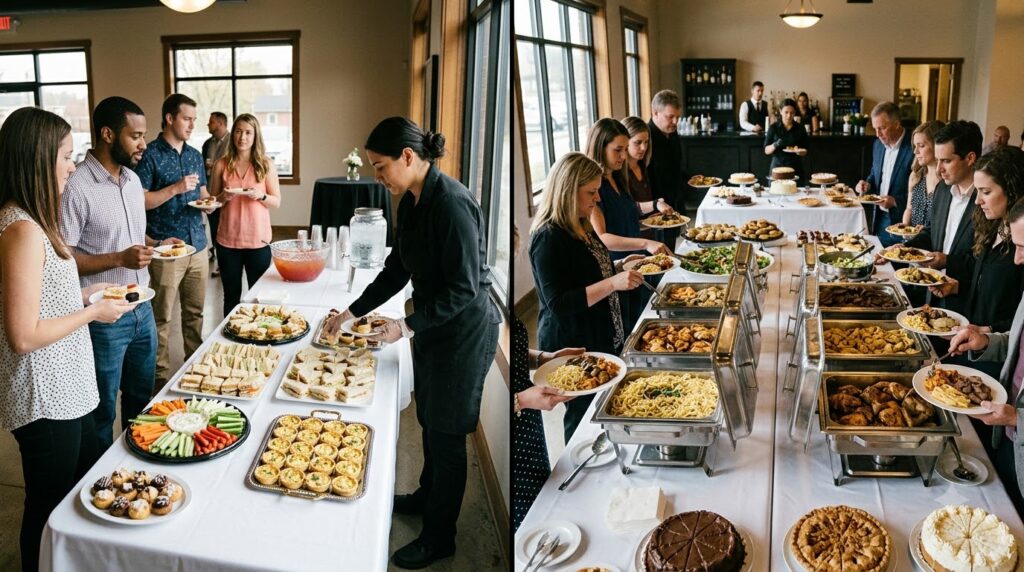
You have 50 guests.
For a two-hour party, you order enough food for 50 people.
For a five-hour party, should you order 2.5 times as much?
No.
A five-hour party does not automatically need 2.5 times the food of a two-hour event.
Event length matters because longer parties can create more opportunities to eat. But catering portions per person depend more directly on what happens during those hours: when the main meal is served, how substantial the appetizers are, whether dessert is included, whether guests return for seconds, and whether another food service happens later.
A five-hour event with dinner at 6:00 PM may need approximately the same main-meal portion per guest as a two-hour dinner.
What changes is everything surrounding that meal.
This guide gives you practical starting quantities, compares two-hour and five-hour parties, and shows how to adjust your catering order without leaving guests hungry or buying mountains of leftovers.
Quick Answer: How Much Catering Food Do You Need Per Person?
There is no universal number, but these general catering benchmarks provide a useful starting point:
| Food | General Starting Quantity Per Person |
|---|---|
| Passed appetizers | 4–6 pieces per hour |
| Buffet-style appetizers | 6–8 pieces for a one-hour appetizer period |
| Plated meat/fish entrée | 4–6 oz |
| Buffet/barbecue protein | 6–8 oz |
| Starch | 4–6 oz |
| Vegetables | 4–6 oz |
| Side salad | About 1 cup |
| Bread | 1–2 pieces |
| Dessert | 1 standard serving or roughly 1–2 small pieces |
| Taco lunch | Roughly 2–3 tacos |
| Tacos as primary meal | Roughly 3–4 tacos, depending on taco size and sides |
These are planning estimates, not guarantees.
WebstaurantStore’s catering portion guide recommends 4–6 ounces of protein for plated dinners and 6–8 ounces for many buffet-style meals.
For tacos specifically, general taco-party guidance suggests roughly 2–3 tacos per person for lunch and 3–4 when tacos serve as the main meal, with appetizers and sides affecting that quantity.
The caterer preparing your actual menu should make the final recommendation because taco size, protein quantity, side portions, service style, and guest mix all change the calculation.
The Better Formula: Guests × Eating Occasions, Not Guests × Hours
Instead of calculating food by the length of the party, calculate around eating occasions.
Think of an eating occasion as a distinct time when guests are expected to eat.
A two-hour dinner might have:
Light appetizers → Dinner → Dessert
A five-hour celebration might have:
Arrival appetizers → Dinner → Dessert → Late snack
The second party may need more overall food.
But it does not need another complete dinner every two hours.
A practical planning formula is:
Guest count + meal timing + portion baseline + eating occasions + service style + buffer
That produces a much more realistic order than:
Guest count × party duration
2-Hour vs 5-Hour Party: What Actually Changes?
Here is the simplest comparison.
| Party Type | Typical Food Structure | Main Meal Quantity | Extra Food Need |
|---|---|---|---|
| 2-hour lunch | Starter + lunch + dessert | Normal meal portion | Low |
| 2-hour dinner | Light apps + dinner + dessert | Normal meal portion | Low |
| 5-hour party with one dinner | Apps + dinner + dessert | Normal meal portion | Moderate |
| 5-hour celebration | Apps + dinner + dessert + late snack | Normal meal portion | Higher |
| 5-hour grazing event | Food available throughout | Different calculation | Potentially much higher |
Notice what does not change automatically.
The main dinner portion.
A five-hour event does not mean every guest suddenly needs three dinners.
Catering Portions Per Person for a 2-Hour Party
Short events usually concentrate eating into one clear meal period.
Suppose your event runs from 6:00 PM to 8:00 PM.
A sensible schedule might look like:
6:00 PM: Guests arrive
6:00–6:30 PM: Light appetizers
6:30 PM: Dinner
7:30 PM: Dessert
8:00 PM: Event ends
Most guests are attending for one complete meal.
That means you can build the catering order around one normal meal portion rather than trying to provide food continuously for two hours.
Example Taco Dinner
If tacos are the main entrée, a general starting point might be roughly 3–4 tacos per adult when tacos are the primary meal, depending on their size and the accompanying dishes.
If guests are also receiving generous rice, beans, chips, guacamole, appetizers, and dessert, the taco requirement may shift.
If the tacos are unusually small, the quantity may move in the other direction.
This is why the number of tacos should ultimately be confirmed with the restaurant preparing them.
What About a 2-Hour Afternoon Party?
Now move the same event to 2:00 PM–4:00 PM.
That no longer sits squarely inside lunch or dinner.
Guests may expect:
- Chips, salsa or dips
- Finger foods
- Light snacks
- Dessert
- Drinks
They may not expect a complete entrée.
So two events with identical guest counts and identical two-hour durations can need completely different amounts of food.
Time of day matters because guests arrive with different expectations and appetites.
Catering Portions Per Person for a 5-Hour Party
Five hours does not tell you enough.
You need the event schedule.
Imagine a graduation party from 4:00 PM to 9:00 PM:
4:00 PM: Guests arrive
4:00–5:00 PM: Appetizers
6:00 PM: Main meal
7:30 PM: Cake or dessert
8:30 PM: Optional late snack
9:00 PM: Party ends
That creates up to four different food moments.
Your main dinner portion does not necessarily need to double.
Instead, the overall order expands because you are feeding guests at multiple stages.
That distinction can save a great deal of unnecessary food.
How Much Food for 50 Guests at a 2-Hour Party?
Imagine 50 adults attending a two-hour taco dinner.
A planning framework could start with:
Appetizers
For a short pre-dinner appetizer period, begin with a light quantity rather than planning an appetizer meal.
General catering guidance puts passed hors d’oeuvres around 4–6 pieces per person per hour.
If appetizers last only 30 minutes and dinner follows immediately, discuss a lighter amount with your caterer.
Tacos
Using a rough 3-taco-per-person starting point for a substantial taco meal:
50 guests × 3 tacos = 150 tacos
Using 4 per person:
50 × 4 = 200 tacos
That gives you a planning range, not an automatic order of 150–200 tacos.
A caterer may recommend fewer or more depending on taco size, sides, appetizers, children, dietary options, and expected appetites.
Sides
Rather than randomly adding trays, estimate sides independently.
A general catering baseline is approximately 4 ounces of a side per person, although the specific dish and number of sides will affect this.
Dessert
Plan roughly one normal dessert serving per guest, with some catering guides suggesting one to two smaller dessert pieces per person.
That creates one complete eating cycle.
You do not need five hours’ worth of food compressed into two.
How Much Food for 50 Guests at a 5-Hour Party?
Keep the same 50 guests.
Now extend the celebration from 4:00 PM to 9:00 PM.
Do not turn 150 tacos into 375 tacos just because the event became 2.5 times longer.
Instead, expand the schedule.
For example:
Arrival: chips, salsa, guacamole or light appetizers
Main meal: taco service
Dessert: cake, churros or another dessert
Late event: optional smaller snack if guests will still be hungry
The taco quantity may remain close to the normal main-meal range.
What grows is the amount allocated to the other eating occasions.
That’s the central difference between a short and long event.
When Should a 5-Hour Party Actually Get More Main-Course Food?
There are situations where increasing the main meal makes sense.
Consider ordering a larger buffer when:
- Guests are known to have larger appetites
- The event involves substantial physical activity
- The meal is the main attraction
- Buffet service encourages seconds
- Guests have very few appetizers beforehand
- Dinner is being served after a long gap
- The guest list is heavily adult rather than child
- The event extends through both lunch and dinner
- Guests will not receive another substantial food service later
Longer events create opportunity for additional consumption.
They do not mathematically determine it.
How Buffet Service Changes Catering Portions
Buffets introduce uncertainty.
With plated service, the caterer determines what lands on each plate.
With a buffet, guests decide.
One person takes one taco.
Another takes four.
Someone builds a mountain of rice and barely touches the protein.
Someone else returns for seconds fifteen minutes later.
For this reason, buffet catering commonly uses somewhat higher protein allocations than plated service. WebstaurantStore suggests approximately 4–6 ounces of meat or fish for a plated dinner and around 6–8 ounces for buffet or barbecue service.
That does not mean every buffet needs massive overordering.
It means the serving format should be built into the calculation.
How Appetizers Change Main-Meal Quantities
Appetizers are not free calories floating outside the catering calculation.
They count.
Compare these two schedules:
Event A
6:00 PM: Guests arrive
6:15–6:30 PM: Chips and salsa
6:30 PM: Dinner
Event B
4:00 PM: Guests arrive
4:00–6:00 PM: Nachos, quesadillas, dips and substantial appetizers
6:00 PM: Dinner
The second group has already spent two hours eating.
Planning identical appetizer and dinner quantities for both events can create unnecessary leftovers.
Tell your caterer whether appetizers are:
- A small welcome bite
- A short pre-meal course
- Substantial hors d’oeuvres
- Available throughout the event
- Intended to partially replace the meal
Those are very different catering plans.
Taco Catering Portions: Think Beyond the Number of Tacos
A taco menu can make portion planning deceptively simple.
“Three tacos each” sounds wonderfully neat.
Real events are less obedient.
Consider everything being served around those tacos.
If guests receive:
- Chips and salsa
- Guacamole
- Quesadillas
- Rice
- Beans
- Nachos
- Toppings
- Dessert
they are not arriving at the taco station with an empty stomach and eating tacos in isolation.
That is why the full catering menu matters to the calculation. You can browse Taco Tequila Co.’s current restaurant menu for ideas, then ask the team which dishes work in catering quantities.
The more components you add, the more the caterer needs to balance each portion against the entire menu.
Why Taco Size Matters
“One taco” is not a standardized catering measurement.
A small street taco and a large restaurant taco do not contain the same amount of food.
The tortilla diameter, amount of protein, toppings, and accompanying sides all affect how many tacos equal a meal.
That means a generic internet recommendation of three tacos per person should never override the caterer’s own serving specifications.
Ask:
How many of your tacos do you normally consider one adult meal when served with these specific sides?
That question is much more valuable than bringing a generic taco calculator to the caterer and insisting it knows their food better than they do.
How Many Extra Portions Should You Order?
Hosts often want a magic buffer percentage.
There isn’t one that works for every event.
Your buffer depends on:
- Certainty of the RSVP count
- Adult-to-child ratio
- Buffet vs plated service
- Appetite of the group
- Variety of food
- Taco or portion size
- Possibility of unexpected guests
- Whether leftovers are desirable
Some taco-party guidance suggests ordering roughly 10–15% extra when additional flexibility is needed, particularly when popular varieties may disappear faster.
Treat that as a planning reference rather than an automatic rule.
If your RSVP count is highly reliable and your caterer portions generously, you may not need the same buffer as a casual open-house party where attendance is unpredictable.
Adults vs Children: Don’t Treat Every Guest as Identical
A headcount of 75 tells you how many humans are coming.
It does not tell you how much they will eat.
Twenty adults plus fifty-five young children is not the same catering problem as seventy-five hungry adults.
Tell your caterer approximately how many guests are:
- Adults
- Teenagers
- Young children
- Guests requiring alternative meals
Children’s portions vary heavily by age.
Teenagers, meanwhile, have occasionally been known to challenge the laws of catering mathematics.
Guest mix matters.
Staggered Arrivals Can Change Your Order
A formal dinner where all 100 guests sit down at 6:30 PM is relatively predictable.
An open-house graduation party from 2:00 PM to 7:00 PM is not.
Some guests arrive at 2:00.
Others appear at 4:30.
Some leave before dinner.
Others stay all evening.
In that situation, your total RSVP count may exaggerate the number of people eating simultaneously.
Tell the caterer whether guests are arriving together or circulating throughout the event.
It can affect both quantity and replenishment.
What About Late-Night Food?
A five-hour event does not automatically need late-night food.
Ask when dinner ends and when the party ends.
Dinner at 7:00 PM with an 8:30 PM departure?
Probably a different situation from dinner at 6:00 PM followed by dancing until midnight.
Late-night food becomes more useful when there is a meaningful gap between the primary meal and departure.
It should usually be treated as a new eating occasion, not as another full dinner.
A lighter service may be enough.
Food Should Be Staged Around When Guests Eat
Long parties create another problem beyond quantity.
If you put five hours of food on the buffet at 4:00 PM, you do not have a quantity strategy.
You have a food parking lot.
Instead, consider staged service:
Arrival food → Main meal → Dessert → Optional late snack
That can improve presentation, food quality, and portion control.
It also helps the catering team replenish food according to actual demand instead of exposing everything at once.
For long events, discuss holding and food-safety requirements with the catering provider as part of the service plan.
2-Hour vs 5-Hour Taco Party Example
Suppose you are planning for 75 guests.
Two-Hour Taco Dinner
6:00 PM: Arrival
6:15 PM: Light chips, salsa and appetizers
6:45 PM: Taco dinner with sides
7:30 PM: Dessert
8:00 PM: End
The focus is one complete meal.
Your caterer can calculate a normal dinner quantity for 75 guests, then add comparatively light appetizers and dessert.
Five-Hour Celebration
4:00 PM: Arrival appetizers
5:30 PM: Taco dinner
7:00 PM: Dessert
8:15 PM: Optional light snack
9:00 PM: End
You still do not need two or three complete taco dinners.
Instead, you have several smaller food periods surrounding one primary meal.
That’s why the longer event needs more total food planning, not a simple multiplication of the entrée.
A Simple Catering Quantity Worksheet
Before contacting a caterer, write down:
Confirmed guests: ___
Expected maximum attendance: ___
Adults: ___
Children: ___
Event start: ___
Event end: ___
Main meal time: ___
Appetizer service length: ___
Main entrée: ___
Number of sides: ___
Dessert: Yes / No
Late snack: Yes / No
Buffet or served: ___
Guests arriving together or staggered: ___
Dietary meals required: ___
Now your caterer can calculate portions around an actual event instead of a mysterious number of people floating through a five-hour window.
Planning Catering With Taco Tequila Co. in New Port Richey
For hosts planning a Mexican-inspired event in New Port Richey, Taco Tequila Co. accepts catering requests through the Catering | Event inquiry form on its Contact page. The restaurant is located at 5316 US-19 N, New Port Richey, FL 34652.
When requesting a catering quote, do not send only:
“I need tacos for 60 people.”
Send:
“We’re planning a five-hour birthday party for approximately 60 guests. Guests arrive at 4:00 PM, we’d like light appetizers during arrival, taco service around 6:00 PM, and dessert at 7:30 PM. About 50 guests are adults and 10 are children. We’d like buffet-style service and want to know whether you recommend any later snacks.”
That gives the catering team enough information to recommend meaningful quantities.
Questions to Ask Before Finalizing the Order
Ask your caterer:
- How many servings does each catering tray or package provide?
- How many tacos from this specific menu equal a normal adult meal?
- Should the appetizer quantity reduce the entrée quantity?
- How much extra should we allow for buffet seconds?
- How should children’s portions be calculated?
- Should dietary meals be included inside or added to the main headcount?
- Does a five-hour schedule justify another food service?
- Can food be replenished in stages?
- How should leftovers be handled?
- When is the final guest count due?
These questions convert broad catering portions per person guidelines into an actual order.
Common Catering Quantity Mistakes
Multiplying Food by Hours
A five-hour event is not 2.5 two-hour events.
Calculate eating occasions instead.
Counting Guests but Ignoring the Menu
Three tacos plus multiple sides is different from three tacos alone.
Forgetting Appetizers
Guests do not magically reset their appetites before dinner.
Treating Every Taco as the Same Size
Always use the caterer’s own menu dimensions and serving guidance.
Assuming Buffet and Plated Portions Are Identical
Buffets create more variation and often require additional flexibility.
Forgetting Children
Age distribution can materially change food quantities.
Serving Everything at Once
Long events benefit from intentional timing and replenishment.
Adding a Full Second Meal “Just in Case”
Sometimes a modest late snack is all that is needed.
Frequently Asked Questions
How much catering food should I order per person?
It depends on the menu. General dinner benchmarks include about 4–6 ounces of protein for plated service and 6–8 ounces for many buffet meals, plus sides and other courses.
How many tacos should I order per person?
A general starting range is approximately 2–3 tacos for lunch or 3–4 when tacos are the main meal. Taco size, sides, appetizers, guest age, and appetite can change that recommendation.
Does a five-hour party need more food than a two-hour party?
Often it needs more overall food, but not necessarily a larger main meal. The difference usually comes from additional appetizers, dessert, seconds, or a later snack.
How much food do I need for 50 guests?
Start with 50 normal meal portions, then adjust for children, buffet service, appetizers, sides, dessert, attendance uncertainty, and additional eating occasions. Do not multiply the quantity by the number of event hours.
How many appetizers should I order per person?
A general benchmark for passed appetizers is around 4–6 pieces per guest per hour. If a full meal immediately follows, your caterer may recommend a lighter appetizer quantity.
Does buffet catering require more food?
It can. Guests control their own portions and may return for seconds. General catering guidance often allocates more protein to buffet meals than plated service.
Should I order extra food for unexpected guests?
A modest buffer can be useful when attendance is uncertain. Some taco-party guidance suggests roughly 10–15% extra, although the appropriate buffer depends on the caterer’s serving size and your RSVP reliability.
Should children count as full catering portions?
Not always. Age matters significantly, so give your caterer the number of adults and children rather than only the total guest count.
Do appetizers reduce how much dinner I need?
Substantial appetizers can reduce demand for the main meal. Light appetizers served shortly before dinner may have much less impact.
Does Taco Tequila Co. offer catering?
Its website accepts catering and event inquiries through the Contact page. Confirm current packages, prices, quantities, delivery, setup, staffing, and availability directly for your event.
Final Takeaway: Count Meals, Not Hours
The most important rule for catering portions per person is surprisingly simple:
Do not calculate food by how long people occupy the venue. Calculate food by when and how they are expected to eat.
For a two-hour event, that may mean one main meal with light appetizers and dessert.
For a five-hour party, it may mean appetizers, the same normal dinner portion, dessert, and a smaller later snack.
Your guest count establishes the base.
The menu determines the serving size.
The event schedule determines how many times you need to feed those guests.
And the service style, guest mix, appetite, and sides determine how much buffer makes sense.
If you’re planning a New Port Richey celebration with Taco Tequila Co., send the team your guest count and your event timeline when requesting a quote. Their website provides a Catering | Event inquiry option for exactly that conversation.
The goal is not to order the maximum possible amount of food.
It’s to have enough food when guests actually want to eat it, without catering the same dinner three times just because the party lasts five hours.