
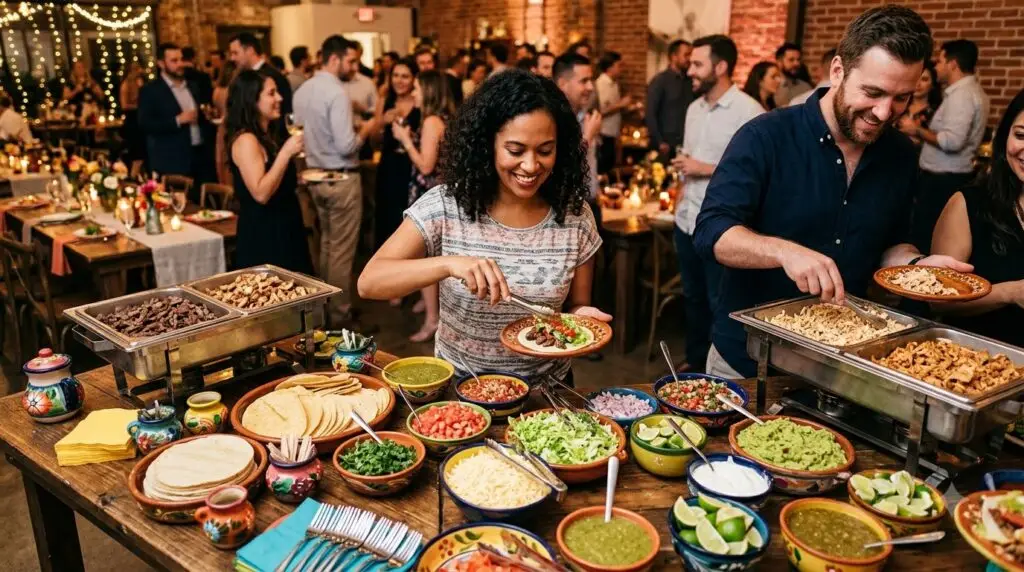
Planning a taco bar sounds simple until you have to answer the question that determines almost everything else:
How many tacos per person do you actually need?
Order too few and guests may leave hungry. Order far too many and you increase food costs, create unnecessary leftovers, and make catering more complicated than it needs to be.
For most parties and events, 3 tacos per adult is a practical starting point for a standard meal. From there, the number should be adjusted based on taco size, side dishes, guest ages, appetite, event timing, and whether tacos are the main meal or just one part of the menu.
This taco bar calculator guide will help you estimate:
- Tacos per person
- Total tacos for different guest counts
- Cooked taco filling
- Tortillas
- Toppings
- Extra food buffer
- Portions for children and larger appetites
- Adjustments for weddings, corporate events, birthdays, and other celebrations
- Food safety and serving considerations
The goal is not simply to order more food “just in case.” It is to build a taco bar that feels generous without becoming wasteful.
How Many Tacos Per Person?
Use the following ranges as a planning starting point:
| Serving Style | Tacos Per Person |
| Appetizer or snack | 1–2 |
| Light lunch with sides | 2–3 |
| Standard taco bar meal | 3 |
| Taco-focused dinner | 3–4 |
| Small street tacos | 4–5 |
| Teenagers or larger appetites | 4–5 |
These are planning estimates rather than universal rules. Taco size makes a major difference.
Three large, loaded tacos are very different from three small street tacos.
If you are ordering from a caterer or restaurant, ask about the size and serving style of the tacos before calculating your final quantity.
Taco Bar Calculator Formula
For a standard taco bar, start with:
Number of Guests × 3 Tacos = Base Taco Quantity
Then decide whether you need a buffer.
For events where the final guest count or individual appetites are uncertain, adding approximately 5% to 10% extra can provide breathing room.
Example for 50 Guests
50 guests × 3 tacos = 150 tacos
With a 10% buffer:
150 + 15 = 165 tacos
You do not automatically need a 10% buffer for every event. If your caterer portions food rather than preparing a fixed number of assembled tacos, the calculation may work differently.
Taco Calculator by Guest Count
Here is a quick reference using 3 tacos per guest as the standard-meal baseline:
| Number of Guests | Base Quantity | With 10% Buffer |
| 10 | 30 tacos | 33 tacos |
| 20 | 60 tacos | 66 tacos |
| 25 | 75 tacos | About 83 tacos |
| 30 | 90 tacos | 99 tacos |
| 40 | 120 tacos | 132 tacos |
| 50 | 150 tacos | 165 tacos |
| 75 | 225 tacos | About 248 tacos |
| 100 | 300 tacos | 330 tacos |
| 150 | 450 tacos | 495 tacos |
Use the base quantity first, then adjust it using the factors later in this guide.
How Many Tacos for 25 People?
For 25 guests:
- Light meal: 50–75 tacos
- Standard meal: 75 tacos
- Taco-focused meal or larger appetites: 75–100 tacos
For a typical party with sides and toppings, 75 tacos is a reasonable starting point.
If you want approximately a 10% cushion, plan for around 80–85 tacos.
How Many Tacos for 50 People?
For 50 guests:
- Light meal: 100–150 tacos
- Standard taco bar: 150 tacos
- Larger appetites or smaller tacos: 175–200 tacos
For a standard event:
50 guests × 3 tacos = 150 tacos
With a 10% buffer:
165 tacos
How Many Tacos for 100 People?
For 100 guests:
- Light meal with substantial sides: 200–300 tacos
- Standard taco bar: 300 tacos
- Small tacos or larger-appetite crowd: 350–400+ tacos
Using the standard calculation:
100 guests × 3 tacos = 300 tacos
With a 10% buffer:
330 tacos
For a group this size, taco size and menu variety become especially important. Before ordering hundreds of tacos based only on a formula, confirm portion sizes with your caterer.
Taco Size Can Completely Change Your Calculation
One of the biggest taco bar planning mistakes is treating every taco as the same size.
Small Street-Style Tacos
Small tacos may require approximately:
4–5 tacos per adult
This is especially true when the tortillas and protein portions are relatively small.
Taco Tequila Co.’s current restaurant menu, for example, includes mini street tacos, showing why taco size needs to be considered rather than relying on guest count alone.
Medium Tacos
For a typical medium taco:
About 3 tacos per adult
is a useful starting point for a complete meal.
Large or Heavily Loaded Tacos
If tacos contain larger portions of protein, vegetables, cheese, sauces, and other ingredients:
2–3 tacos per person
may be sufficient, especially when sides are included.
How Much Taco Meat Do You Need Per Person?
Counting tacos is only half of the calculation.
If you are building a taco bar rather than ordering individually prepared tacos, you also need to estimate the total filling.
A useful planning range for small-to-medium tacos is approximately:
1.5–2 ounces of cooked filling per taco
If each adult eats three tacos, that equals approximately:
4.5–6 ounces of cooked filling per person
or roughly:
0.28–0.38 pounds of cooked filling per adult
Cooked Taco Filling Calculator
| Guests | Approximate Cooked Filling |
| 25 | 7–9.5 lbs |
| 50 | 14–19 lbs |
| 75 | 21–28 lbs |
| 100 | 28–38 lbs |
| 150 | 42–56 lbs |
These numbers represent total cooked filling, not the amount required for each protein option.
For example, if you need 30 pounds of total cooked filling for a large event and are serving chicken, beef, and a vegetarian option, you would divide that total across those choices rather than preparing 30 pounds of each.
Raw Weight and Cooked Weight Are Not the Same
If you are purchasing raw meat yourself, do not use cooked serving weight as your raw purchasing amount.
Meat loses moisture and sometimes fat during cooking, and the amount of loss varies depending on:
- Type of meat
- Cut
- Fat content
- Cooking method
- Trimming
If you are catering a large event, ask your caterer or food supplier to convert the desired cooked portion into the appropriate raw purchase quantity.
That is more reliable than using one universal raw-to-cooked conversion for chicken, steak, pork, and other proteins.
How Many Taco Fillings Should You Offer?
Variety improves a taco bar, but too many proteins can make portion planning unnecessarily complicated.
For many medium or large events, a practical combination is:
- 2 meat or seafood options
- 1 vegetarian option
For example:
Option 1
- Grilled chicken
- Carne asada
- Grilled vegetables
Option 2
- Chicken
- Pork
- Beans or vegetable filling
Option 3
- Beef
- Chicken
- Fish or shrimp
- Vegetarian option for a larger guest list
The right mix depends on your guests.
If you already know that 20% of attendees are vegetarian, plan intentionally for that rather than assuming vegetarian filling will only be used as a backup.
How Many Tortillas Do You Need?
For standard tacos:
1 taco = 1 tortilla
Then add approximately 5% to 10% extra tortillas for:
- Torn tortillas
- Extra servings
- Guests who build additional tacos
- Handling loss during service
For 150 tacos, for example, approximately 160–165 tortillas provides a modest cushion.
What About Double-Stacked Street Tacos?
Some street-style tacos use two tortillas per taco.
If your tacos will be double-stacked:
Number of Tacos × 2 = Tortilla Requirement
Always confirm the serving style before ordering tortillas. Otherwise, your “extra” tortillas can disappear before the taco bar has served half the room.
How Much Taco Topping Do You Need Per Person?
Toppings are harder to calculate than tacos because guests do not use them evenly.
One person may load a taco with guacamole and salsa. Another may want only onion and cilantro.
For a taco bar with several topping options, the following ranges can work as general planning estimates:
| Topping | Approximate Amount Per Guest |
| Cheese | 1–1.5 oz |
| Salsa | 2–3 oz |
| Guacamole | 1.5–2 oz |
| Sour cream or crema | 1–1.5 oz |
| Lettuce and fresh vegetables | 2–3 oz combined |
| Onion and cilantro | 0.5–1 oz combined |
You usually do not need enough of every topping for every guest to take a full portion.
The more topping choices you provide, the more guest preferences will spread across the options.
Essential Taco Bar Toppings
A balanced taco station can include a mixture of fresh, creamy, spicy, acidic, and crunchy ingredients.
Fresh Toppings
- Chopped onions
- Cilantro
- Lettuce
- Tomatoes or pico de gallo
- Lime wedges
Cheese
Options can include:
- Cotija
- Queso fresco
- Shredded cheese
Salsa and Heat
Consider offering more than one heat level:
- Mild salsa
- Medium salsa
- Hot salsa
- Hot sauce
- Jalapeños
Creamy Toppings
- Guacamole
- Sour cream
- Crema
Optional Extras
- Pickled onions
- Radishes
- Roasted peppers
- Corn
- Beans
The goal is variety without turning the taco table into a grocery-store aisle.
Do Side Dishes Reduce the Number of Tacos You Need?
Usually, yes.
If tacos are served alongside filling sides such as:
- Mexican rice
- Beans
- Street corn
- Chips and salsa
- Salad
- Nachos
guests may eat fewer tacos than they would at a taco-only meal.
For a dinner with several substantial sides, staying near 2.5–3 tacos per adult may be appropriate.
If tacos are the only meaningful food being served, 3–4 tacos per person gives you a more comfortable planning range.
Factors That Change How Many Tacos Per Person You Need
A taco calculator should be the beginning of your planning, not the end.
Before placing the order, consider the following.
Guest Appetite
Teenagers, athletes, and groups with larger appetites may eat more than a mixed-age crowd.
For those events, move toward the upper end of your taco range.
Children
Young children often eat less than adults.
Depending on age and taco size, 1–2 tacos per child may be enough.
Teenagers should generally be counted much closer to adult portions.
Time of Day
Lunch portions can be lighter than dinner portions.
A taco station served as a snack after guests have already eaten dinner needs far less food than tacos served as the primary meal.
Event Duration
At longer events, guests may return to the taco bar multiple times.
If food remains available for an extended period, additional portions may be useful.
Number of Sides
The more substantial sides you serve, the less pressure there is on tacos to provide the entire meal.
Taco Size
This deserves repeating because it has such a large effect.
Four mini street tacos can contain less food than two heavily loaded restaurant-style tacos.
Ask about size first. Calculate second.
Taco Planning by Event Type
Different events create different eating patterns.
Weddings
If tacos are the main dinner but guests also receive appetizers, sides, dessert, or other food:
Approximately 2.5–3 tacos per adult may be a reasonable starting point.
If tacos are the primary meal with limited sides, move closer to 3–4.
Corporate Lunches
For a corporate lunch with sides:
2–3 tacos per person
may work well depending on taco size.
Also consider service speed. Employees arriving at a taco bar at roughly the same time can create a line even when food quantity is perfect.
Birthday Parties
For mixed adult and child groups:
- Adults: approximately 3 tacos
- Younger children: approximately 1–2 tacos
- Teenagers: calculate closer to adult or larger-appetite portions
Graduation Parties and Casual Gatherings
Guest arrival times may be staggered, which makes a taco bar particularly convenient.
A baseline of 3 tacos per adult, adjusted for sides and taco size, provides a useful starting point.
Late-Night Taco Station
If tacos are served after a full dinner:
1–2 small tacos per guest
may be enough as a late-night snack.
If the late-night taco station is the only substantial meal, calculate it as a normal dinner instead.
Planning for Vegetarian and Dietary Needs
A complete taco calculator should account for more than total guest count.
Before finalizing your menu, identify guests who may need:
- Vegetarian options
- Vegan options
- Gluten-conscious choices
- Dairy-free choices
- Mild food
- Allergy accommodations
Do not assume that a particular tortilla or filling automatically makes an entire taco suitable for a dietary restriction.
Ingredients, sauces, preparation surfaces, fryers, and serving utensils can create cross-contact.
For guests with allergies or medical dietary restrictions, confirm ingredients and preparation practices directly with the restaurant or caterer.
How to Set Up a Taco Bar for Better Serving Flow
Having enough food does not help much if 75 people are trapped behind one bowl of salsa.
Arrange the taco bar in the same order guests naturally build their food.
Station 1: Plates and Tortillas
Start with:
- Plates
- Napkins
- Warm tortillas
Station 2: Proteins and Main Fillings
Place the primary fillings next.
Clearly label each option so guests do not have to stop the line to ask what everything is.
Station 3: Fresh and Creamy Toppings
Follow with:
- Cheese
- Lettuce
- Pico de gallo
- Onion
- Cilantro
- Guacamole
- Crema
Station 4: Salsa and Finishing Ingredients
Finish with:
- Mild salsa
- Hot salsa
- Jalapeños
- Lime
- Hot sauce
Station 5: Sides
For a large crowd, keeping sides separate can reduce congestion around the taco-building area.
For very large events, duplicating popular toppings or creating two serving lines can improve flow even more.
Keep Your Taco Bar Safe During Service
Food quantity matters, but safe holding temperatures matter more.
The USDA advises keeping hot foods at 140°F or above and cold foods at 40°F or below during service. Perishable food should generally not remain at room temperature for more than two hours. If the temperature is above 90°F, that limit drops to one hour.
This is especially important for outdoor celebrations in warm weather.
For safer buffet service:
- Use chafing dishes or appropriate warming equipment for hot fillings
- Keep cold toppings properly chilled
- Serve smaller quantities and replenish them rather than placing everything out at once
- Use clean serving utensils for each ingredient
- Monitor foods during longer events
- Follow the caterer’s instructions for holding and storing leftovers
Common Taco Bar Planning Mistakes
Ordering Based Only on Guest Count
Fifty guests does not automatically mean every event needs the same amount of food.
Taco size, sides, age, appetite, and event style matter.
Forgetting to Ask About Taco Size
This is one of the fastest ways to miscalculate quantities.
Buying Enough of Every Protein for Every Guest
If you have three filling choices, you do not need three full meals per person.
Calculate your total filling requirement first, then divide that amount between the options.
Confusing Raw and Cooked Meat Weight
Always know whether a quantity refers to meat before or after cooking.
Offering Too Many Choices
More variety can sound better on paper, but it can increase cost, leftovers, setup complexity, and serving time.
Choose options that give guests meaningful variety rather than endless variety.
Forgetting Dietary Needs
Find out about vegetarian, vegan, allergy, and other dietary requirements before ordering.
Ignoring Serving Flow
A poorly organized taco bar can create long lines even when the food quantities are perfect.
Adding a Large Buffer Automatically
Extra food can protect against uncertainty, but “more” is not always better.
Use a buffer when guest count or appetite is uncertain rather than automatically overordering every ingredient.
Taco Bar Planning Checklist
Before finalizing your taco catering order, confirm:
Guest Count
- Final number of guests
- Adults, teenagers, and younger children
- Dietary restrictions or allergies
- Expected guest arrival pattern
Taco Quantities
- Taco size confirmed
- Tacos are appetizer, snack, lunch, or main meal
- Base quantity calculated
- Appropriate buffer considered
Menu
- Protein and filling options selected
- Vegetarian option planned if needed
- Tortilla quantity calculated
- Toppings selected
- Sides selected
- Drinks and desserts planned separately
Event Logistics
- Serving time confirmed
- Buffet or staffed service decided
- Indoor or outdoor setup confirmed
- Hot and cold food holding planned
- Serving tables and utensils arranged
- Caterer deadlines confirmed
Frequently Asked Questions About Taco Bar Portions
How many tacos should I plan per adult?
For a standard meal, 3 medium tacos per adult is a practical starting point.
Adjust upward for smaller tacos, larger appetites, or limited sides. Adjust downward if the tacos are large or served alongside several substantial dishes.
How many tacos should I plan for children?
For younger children, approximately 1–2 tacos each may be enough depending on taco size and age.
Teenagers should generally be counted closer to adult portions.
How much cooked taco meat should I plan per person?
If you are serving approximately three small-to-medium tacos, a useful planning range is around 4.5–6 ounces of cooked filling per adult.
The exact amount depends on how heavily each taco is filled.
How many tortillas should I buy?
Start with one tortilla per taco and add approximately 5% to 10% extra.
If you are serving double-stacked street tacos, calculate two tortillas per taco.
Should I add 10% extra tacos?
Not always.
A buffer of approximately 5% to 10% can be helpful when the final guest count or appetite is uncertain. For a tightly confirmed event with substantial sides and professionally portioned catering, a large buffer may not be necessary.
How many taco fillings should I offer?
For many medium-to-large events, two primary proteins plus one vegetarian option provides enough variety without making portion planning overly complicated.
Smaller events may need fewer options.
Can I serve fewer tacos if I have rice, beans, and other sides?
Yes.
Filling side dishes can reduce taco consumption, so you can usually stay closer to the lower end of your recommended taco range.
Is it better to order individual tacos or a taco bar?
It depends on the event.
Individually portioned tacos make quantity control simpler. A taco bar gives guests more control over fillings, toppings, and portion sizes but requires more planning for ingredients and serving flow.
Planning Taco Catering With Taco Tequila Co.
Once you know your guest count, taco size, approximate portions, and dietary needs, the next step is turning those numbers into an actual menu.
Taco Tequila Co. in New Port Richey promotes Mexican food catering and private-event services and is also connected with Trio’s Event & Catering for celebrations and events.
Instead of relying on a generic calculator alone, share the important details of your event with the catering team:
- Guest count
- Adults and children
- Event type
- Serving time
- Taco preferences
- Dietary requirements
- Side dishes
- Desired service style
A calculator gives you a strong starting point. A final catering plan should account for the actual taco size, menu, event schedule, and guests.
Final Taco Calculator Takeaway
If you need one number to begin planning, start here:
3 tacos per adult for a standard taco bar meal.
Then adjust.
Choose fewer if you are serving large tacos and substantial sides.
Choose more if you are serving mini street tacos, feeding a larger-appetite crowd, or making tacos the entire meal.
And before placing a large catering order, confirm taco size and portions with the people actually preparing the food.
That simple step can save you from both sides of the taco-planning problem: an empty serving tray too early in the night or a refrigerator full of leftovers the next morning.
For events in New Port Richey, Taco Tequila Co. can help turn your guest count and menu ideas into a taco experience designed around your celebration.