
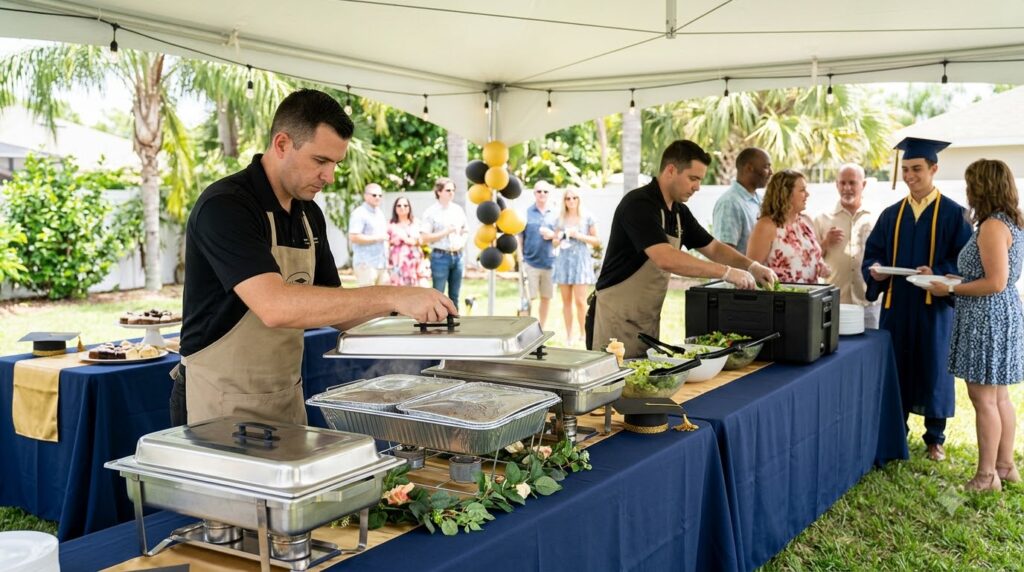
Graduation parties have one scheduling problem that ordinary dinners usually do not.
Nobody arrives exactly when you expect.
The ceremony runs late. Parking takes longer. One side of the family stops for photographs. Friends arrive in waves. The graduate disappears into fifteen conversations before making it anywhere near the buffet.
Meanwhile, the food has its own clock.
That is why a successful graduation party catering New Port Richey timeline should not begin with the question:
“What time does the party start?”
Start with:
“What time should guests actually begin eating?”
Once the buffet-opening time is established, work backward to determine when staff should arrive, when equipment should be ready, when temperature-sensitive food should arrive, and when the first refill should happen.
For many staffed events, setup may begin roughly 60–90 minutes before food service, while food itself can often arrive considerably closer to buffet opening. Those are planning ranges rather than universal rules. Your final timing should come from the catering team responsible for your menu and venue.
Quick Answer: What Does a Graduation Catering Timeline Look Like?
A practical graduation-party schedule may look like this:
| Time Relative to Buffet Opening | Planning Task |
|---|---|
| 90–60 minutes before | Staff/setup team arrives if substantial setup is required |
| 60–30 minutes before | Tables, holding equipment, labels, serviceware and beverage areas are completed |
| 30–20 minutes before | Food arrives or moves into appropriate hot/cold holding |
| 15–10 minutes before | Order, temperatures, dietary dishes and serving tools are checked |
| Buffet opening | Guests are invited to eat |
| 10–15 minutes after | First complete inspection of quantities, cleanliness and guest flow |
| 20–30 minutes after | Likely first meaningful refill of fast-moving items |
| Throughout service | Continue monitoring quantities and food temperatures |
| End of planned service | Close, safely store eligible leftovers and remove food that cannot be retained |
The important word is planning.
A small backyard drop-off does not need the same lead time as a 150-person staffed graduation buffet.
Build the Timeline Backward From the Meal
Suppose your invitation says:
Graduation Celebration: 4:00 PM
Do not automatically tell the caterer that dinner begins at 4:00.
Instead, decide what guests are supposed to experience.
Perhaps you want:
4:00 PM: Guest arrival
4:00–4:30 PM: Drinks, greetings and photos
4:25 PM: Short toast to the graduate
4:30 PM: Buffet opens
5:00 PM: First major refill period
5:45–6:00 PM: Final meal service
6:15 PM: Cake and dessert
Now you have an actual catering schedule.
The buffet opening at 4:30 PM becomes the anchor.
Everything else can be scheduled around it.
Separate Staff Arrival From Food Arrival
This distinction solves one of the most common catering-timeline mistakes.
The catering team arriving and the food arriving do not necessarily need to happen at the same time.
Staff may need to arrive early to:
- Find the unloading area
- Confirm tables
- Set up chafing equipment
- Arrange cold-food holding
- Prepare serving utensils
- Position plates and napkins
- Label dietary items
- Organize beverages
- Check trash stations
- Review guest flow
That does not mean temperature-sensitive food should sit at the venue during the entire setup period.
The better conversation with your caterer separates four times:
- Staff arrival
- Equipment/setup arrival
- Food arrival
- Buffet opening
Once those four are clear, the rest of your graduation schedule becomes much easier to coordinate.
When Should Catering Staff Arrive?
For a staffed buffet requiring equipment and setup, roughly 60–90 minutes before service can be a useful planning range.
A simple event may need less.
A larger celebration involving several stations, complex decor, limited unloading access or a long walk from the parking area may need more.
Before setting the arrival time, ask:
- When can vendors enter the venue?
- Is there a dedicated loading entrance?
- How far is unloading from the buffet?
- Are the catering tables already set?
- Who supplies linens?
- Who provides chafing dishes?
- Who sets up beverages?
- Does the caterer need electricity?
- Does another vendor occupy the same setup area?
“Arrive at 3:00” is not enough information if the caterer cannot physically access the room until 3:30.
When Should the Food Arrive?
Food usually does not benefit from arriving dramatically early.
For a straightforward buffet, approximately 20–45 minutes before the planned opening can be a reasonable conversation point with your caterer.
Closer to 20 minutes may work when:
- The setup is already complete
- It is primarily a drop-off
- The buffet is simple
- Food can transfer immediately into suitable holding
More lead time may be useful when:
- Several dishes must be staged
- There are separate hot and cold stations
- Dietary meals need labeling
- Staff must assemble a taco station
- The venue has complicated access
- Multiple trays require organization
The caterer should determine the final delivery and holding plan for the actual menu.
Staffed Catering vs Drop-Off: The Timeline Is Different
These two services should not be scheduled the same way.
Staffed Catering
The team may arrive significantly before the meal.
Staff can prepare the service area, receive food, monitor holding equipment, open the buffet, replenish dishes and handle breakdown depending on the package.
Drop-Off Catering
The host or venue may already need to have the service area prepared before delivery.
That can include:
- Tables
- Power access
- Ice
- Plates
- Napkins
- Serving utensils
- Waste containers
- Appropriate hot/cold holding equipment
In a drop-off situation, clarify who becomes responsible for monitoring the buffet after the delivery person leaves.
Do not discover that answer while the first tray is cooling on the table.
When Should You Open the Buffet?
For an open-house-style graduation party, opening the buffet roughly 20–30 minutes after the advertised start can work well when guests are expected to arrive gradually.
That gives people time to:
- Congratulate the graduate
- Get a drink
- Find relatives
- Take photographs
- Set down gifts
- Wait for other immediate family members
But this should not become an inflexible rule.
Open Earlier When:
- Most guests arrive together
- The invitation promises food at a specific time
- Children or older relatives need to eat promptly
- The party begins during a normal meal period
- Guests came directly from a long ceremony
Open Later When:
- Guests are traveling from a ceremony
- Parking is unpredictable
- The party uses a broad open-house window
- The graduate has scheduled photographs first
- Guests are clearly arriving in waves
The smartest solution is often publishing the meal time.
For example:
Celebration begins at 4:00 PM. Taco buffet opens at 4:30 PM.
Now your guests and caterer are working from the same clock.
Don’t Wait for Every Guest Before Opening
This is where graduation hosts get trapped.
Uncle David says he is ten minutes away.
A family from the ceremony is still parking.
Three friends are taking photographs across town.
Meanwhile, eighty people are standing near the buffet performing increasingly unsubtle reconnaissance.
If you have published a meal time and most guests are present, serve according to the plan.
Reserve appropriately held food for later arrivals instead of forcing everyone else to wait indefinitely.
What If the Graduation Ceremony Runs Late?
Build this possibility into the schedule before the day begins.
If the party immediately follows a ceremony, ask:
What is the earliest realistic arrival time?
and
What is the likely arrival time if the ceremony runs 30 minutes late?
Your caterer should know that range.
For example:
Ceremony scheduled to end: 2:30 PM
Travel to venue: 20 minutes
Expected party arrival: 3:15 PM
Buffet target: 4:00 PM
Delay buffer: approximately 30 minutes
Now the food does not have to sit waiting because the ceremony took longer than expected.
This is particularly useful for graduation party catering in New Port Richey when guests are moving between a ceremony location, parking area and separate party venue.
What Should Guests Eat While Waiting for the Main Buffet?
If arrivals are staggered, consider a small arrival phase before the full meal.
That might include menu-appropriate starters such as chips, salsa or another appetizer arrangement.
Keep this separate from temperature-sensitive main buffet items unless they are being properly held.
The purpose is not to serve half the dinner early.
It is to give arriving guests something intentional while the main meal stays on schedule.
When Should You First Check the Buffet?
Almost immediately.
Do not open the buffet and then disappear for forty-five minutes.
A first complete check around 10–15 minutes after opening is a useful operating habit.
Look at:
- Which protein is disappearing fastest
- Tortilla supply
- Popular sides
- Cold toppings
- Sauces
- Serving utensils
- Plates
- Napkins
- Spills
- Guest flow
- Food temperatures
The first fifteen minutes tell you how the crowd is actually eating.
That is more useful than guessing before service.
When Should the First Refill Happen?
For many buffets, a significant first refill may occur around 20–30 minutes after opening.
But do not refill by stopwatch.
Refill according to consumption.
If chicken disappears twice as quickly as another filling, chicken needs attention first.
If rice barely moves, topping it off simply because thirty minutes passed creates unnecessary waste.
Think of refill timing as continuous monitoring + demand-based replenishment.
Don’t Put Every Tray Out at Once
A better buffet often begins with enough food for strong initial service while properly holding reserve food for later.
This can help:
- Keep food looking fresher
- Reduce time exposed on the buffet
- Improve temperature management
- Handle late arrivals
- Limit unnecessary waste
- Make final-service decisions easier
The exact batch sizes should be determined with your caterer.
Avoid treating an arbitrary percentage split as a universal rule.
A 40-person backyard party and a 200-person banquet should not use identical replenishment mathematics.
How a Taco Buffet Changes Refill Priorities
A taco buffet is modular.
That is useful, but it creates several refill points.
You are not monitoring one entrée.
You may be monitoring:
Hot items: Proteins, rice, beans, queso and tortillas.
Cold items: Salsa, guacamole, sour cream, cheese, lettuce, pico de gallo or other toppings.
Dry/service items: Chips, plates, napkins, utensils and takeaway containers if used.
The fastest-moving item can shift throughout the meal.
Proteins and tortillas may disappear quickly during the first rush.
Later, plates or a popular salsa might become the bottleneck.
Assigning someone to watch the entire station is far better than waiting for a guest to announce:
“We’re out of tortillas.”
Keep Tortillas in Smaller Rounds
For a taco-centered graduation party, tortillas deserve their own replenishment plan.
Putting every tortilla out at opening can reduce quality over a longer buffet period.
Ask the caterer how tortillas will be held and replenished.
Smaller rounds can keep the station more appealing while allowing reserve food to remain properly held.
The same logic can apply to toppings.
A smaller clean container that is replenished appropriately may work better than an enormous pan sitting through the entire party.
Food Safety Has Its Own Clock
Catering timing is not only about convenience.
Food safety sets boundaries.
USDA guidance says hot food should be maintained at 140°F or above, while cold food should remain at 40°F or below. Appropriate equipment may include heated chafing dishes or other hot-holding equipment for hot food, and refrigeration, insulated cold storage or ice for cold food.
If perishable food is not being maintained at safe temperatures, USDA’s general rule is no more than two hours at room temperature.
When the outdoor temperature exceeds 90°F, that limit becomes one hour.
That one-hour rule matters particularly for outdoor Florida graduation celebrations.
Sunshine does not negotiate with your buffet schedule.
Use a Thermometer, Not Guesswork
Food can look hot while being below a safe holding temperature.
Cold food can look perfectly normal while warming into the danger zone.
USDA recommends using a food thermometer to verify temperatures rather than relying on appearance or touch.
Someone should know who is responsible for those checks.
For staffed catering, clarify whether that responsibility remains with the service team.
For drop-off catering, ask what instructions the provider gives the host after delivery.
A Sample Timeline for a 4:00 PM Graduation Party
Suppose you have a 4:00 PM invitation and want guests eating at 4:30 PM.
2:45–3:00 PM
Event or catering team begins setup if a substantial staffed setup is required.
Confirm tables, power, waste area, service route and holding equipment.
3:15 PM
Stage plates, napkins, serving utensils, beverage supplies and dietary labels.
3:45–4:00 PM
Food arrives or transfers into the appropriate holding setup according to the caterer’s plan.
Verify the order before guests begin lining up.
4:00 PM
Guests arrive.
Offer beverages and planned starters.
4:20 PM
Give the welcome, graduation toast, prayer or short acknowledgment.
4:30 PM
Open the main buffet.
4:40–4:45 PM
Check fast-moving dishes, utensils, spills, line speed and food temperatures.
4:50–5:00 PM
Begin meaningful replenishment where needed.
5:00–5:45 PM
Continue monitoring and replenishing according to demand.
5:45–6:00 PM
Move toward the planned final-service phase.
Safely hold, refrigerate or discard remaining perishable food according to the caterer’s procedures and applicable food-safety limits.
After Main Service
Cake, dessert, photographs and the rest of the party continue without the main buffet having to remain fully open for the entire event.
A Sample Timeline When Guests Come Directly From Graduation
This version needs more flexibility.
Suppose the ceremony is expected to finish at 3:00 PM.
Guests need approximately 25 minutes to reach the party.
Instead of promising dinner at 3:30 PM, build a little breathing room.
3:00 PM: Scheduled ceremony end
3:00–3:30 PM: Exit, photographs and parking
3:30–4:00 PM: Guests travel and arrive
4:00 PM: Drinks and light starters
4:30 PM: Main buffet opens
5:00 PM: Refill period
Now a 15-minute ceremony delay does not immediately destroy the food-service plan.
A Sample Drop-Off Timeline
Drop-off catering changes the host’s responsibilities.
Suppose the buffet opens at 5:00 PM.
4:00 PM: Host finishes tables, beverages, plates and service area
4:20 PM: Appropriate holding equipment is ready
4:30–4:40 PM: Catering delivery arrives
4:40 PM: Order is checked and food moves into the agreed service/holding setup
4:50 PM: Dietary dishes and serving utensils are confirmed
5:00 PM: Buffet opens
5:10 PM onward: Host or assigned buffet lead monitors according to the caterer’s instructions
The important difference is that once a drop-off provider leaves, somebody still owns the buffet.
Decide who that person is before the party.
How Long Should the Graduation Buffet Stay Open?
There is no universal buffet duration.
A focused meal service may need only 60–90 minutes.
An open-house celebration may require a different approach.
But keeping every original buffet pan fully open for four hours simply because the party lasts four hours is rarely the best strategy.
Consider:
- When most guests arrive
- Whether late guests are expected
- Food-holding requirements
- Staffing duration
- Dessert timing
- Whether another snack will be offered
- Leftover plans
As demand falls, your caterer may be able to consolidate service appropriately rather than maintaining a full opening spread.
What Happens to Leftovers?
Discuss this before the party.
Food that has remained within safe temperature control may be handled differently from food that has spent too long outside safe holding conditions.
USDA advises putting eligible leftovers in shallow containers and refrigerating them promptly, and discarding perishable food that has exceeded the applicable two-hour or one-hour time limit.
Ask the caterer:
- Who provides leftover containers?
- What food can be retained?
- Who packages it?
- Is refrigeration available?
- When should leftovers be moved?
- What must be discarded?
Do not make the decision based on whether the food still smells good.
Common Graduation Catering Timeline Mistakes
Making Food Arrive at Party Start
The catering schedule should revolve around meal time, not automatically invitation time.
Putting Everything Out Immediately
Reserve food can often be managed more effectively than exposing the entire order from the first minute.
Waiting for Every Guest
Late arrivals should not hold the entire party hostage.
Forgetting Ceremony Delays
Graduation ceremonies have their own sense of time. Build a buffer.
Having No Buffet Monitor
Someone should be checking food, utensils, plates, cleanliness and temperature.
Refilling Every Dish Equally
Refill what guests are actually eating.
Leaving the Buffet Fully Open for the Entire Party
Party duration and buffet duration do not have to match.
Ignoring Florida Heat
When outdoor temperatures exceed 90°F, the general limit for perishable food without proper temperature control drops to one hour.
Planning Graduation Party Catering With Taco Tequila Co.
Taco Tequila Co. is located at 5316 US-19 N, New Port Richey, FL 34652, and its website includes a Catering | Event inquiry form on the Contact page.
Because packages, menus and availability can change, confirm the exact service arrangement for your graduation party rather than assuming every option is included automatically.
When making your inquiry, provide more than the guest count.
Include:
- Graduation date
- Party address or venue
- Invitation time
- Planned buffet time
- Estimated guest count
- Maximum possible guest count
- Ceremony end time if applicable
- Staffed or drop-off preference
- Indoor or outdoor setting
- Menu preferences
- Dietary requirements
- Available refrigeration or holding equipment
- Desired service duration
- Cleanup and leftover needs
That gives the catering team enough information to build the food schedule around the actual party.
What If You Need a Larger Graduation Venue?
For a larger celebration, Trio’s Banquet Hall at the same New Port Richey address currently lists 4,500 square feet of event space, capacity for up to 250 guests (or up to 120 guests in half the hall), AV equipment, free parking and catering options.
That may be relevant when the graduation party needs more than food delivery and requires a dedicated event space.
A banquet-hall event can also simplify some timeline variables because setup areas, guest seating and catering logistics can be planned together.
Exact availability, packages and catering arrangements should be confirmed directly with the venue.
What to Ask Before Booking Graduation Catering
Ask the provider:
- What time should your team arrive?
- What time should the food arrive?
- How long does setup require?
- What exact time should the buffet open?
- Who provides hot- and cold-holding equipment?
- Who monitors food temperatures?
- Who refills the buffet?
- How frequently will the station be checked?
- How are late arrivals handled?
- What happens if the ceremony runs late?
- How long will staffed service continue?
- How are leftovers handled?
- Who provides plates, napkins and serving utensils?
- When is the final guest count due?
- What happens if attendance changes?
Getting those answers in advance prevents surprisingly complicated conversations beside a half-empty taco tray.
Frequently Asked Questions
How early should catering arrive for a graduation party?
For staffed catering with a meaningful setup, roughly 60–90 minutes before buffet service can be a useful planning range. A simpler drop-off may need considerably less time. Confirm the exact arrival window with your caterer.
How early should the food itself arrive?
For many straightforward events, temperature-sensitive food may arrive roughly 20–45 minutes before the buffet opens rather than at the beginning of the entire setup period. The caterer should determine the actual timing.
Should the buffet open as soon as the party starts?
Not necessarily. For an open-house-style event, allowing roughly 20–30 minutes for arrivals can work well. If the invitation promises a meal at a specific time or everyone arrives together, open according to that schedule.
How often should the graduation buffet be checked?
Checking approximately every 10–15 minutes during active service is a useful operating rhythm. Actual refills should be based on consumption rather than a rigid timer.
When should the first buffet refill happen?
The first significant refill often becomes necessary around 20–30 minutes after service begins, especially during the initial rush. Fast-moving items may need attention sooner.
How long can hot food stay on a buffet?
Properly hot-held food should remain at 140°F or above. The two-hour rule applies when perishable food is not being maintained at safe temperatures.
How long can cold food remain outside?
Cold perishable food should generally be held at 40°F or below. If it is not being appropriately temperature-controlled, the general room-temperature limit is two hours, reduced to one hour when outdoor temperatures exceed 90°F.
What if graduation guests arrive at different times?
Publish a meal time, serve the main group on schedule and coordinate appropriately held reserve food for later arrivals rather than delaying the entire buffet.
What if the ceremony runs late?
Build a buffer between the expected ceremony ending and buffet opening. Tell the caterer in advance that arrival times depend on a ceremony so the service schedule can be designed with that risk in mind.
Is drop-off catering enough for a graduation party?
It can be for a smaller event when the host is prepared to handle setup, holding, monitoring, replenishment and cleanup. Larger parties may benefit from staffed service.
Does Taco Tequila Co. provide graduation catering?
Its website accepts catering and event inquiries through the Contact page. Confirm graduation catering availability, delivery, setup, staffing, packages and pricing directly for your event.
Final Takeaway: Schedule the Food Around the Celebration
A good graduation party catering New Port Richey timeline does not begin when the invitation says the party starts.
It begins with the moment you want guests to eat.
Choose that time first.
Then work backward:
Buffet time → Food arrival → Setup → Staff arrival
After service begins, move forward:
Open → Inspect → Refill → Monitor → Final service → Leftovers
That sequence gives the caterer a real operating plan while giving your family room for the reason everyone gathered in the first place: celebrating the graduate.
For Taco Tequila Co., the restaurant’s website provides a Catering | Event inquiry form for its New Port Richey location.
When requesting your quote, send the team the party start time and the desired buffet opening time.
Those are not the same thing.
Getting that distinction right can make the entire event run more smoothly.