
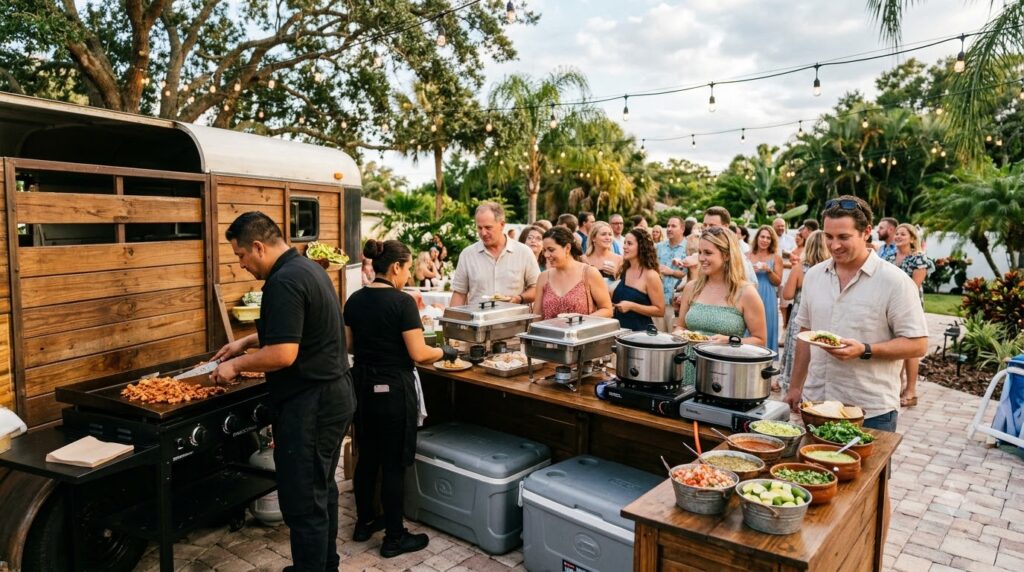
A backyard birthday, graduation party, poolside celebration, park gathering, or outdoor reception can give you plenty of space for guests while giving your caterer almost nowhere to work.
No commercial refrigerator.
No prep kitchen.
Maybe one electrical outlet.
Perhaps a pavilion, folding tables, and whatever the Florida weather decides to contribute that afternoon.
That does not automatically make taco catering a bad fit.
It means the catering plan has to be designed around the venue instead of pretending the venue is a restaurant.
If you are considering taco catering in New Port Richey, figure out what your location can actually support before choosing the final menu. Refrigeration, electricity, water, shelter, unloading access, event duration, and venue rules can all change how food should be transported, held, replenished, and served.
The smartest question is therefore not simply, “How many tacos should I order?”
It is:
How will this food move safely and efficiently from the caterer’s kitchen to my guests’ plates?
Quick Answer: Can You Have Taco Catering Without a Kitchen or Refrigerator?
Potentially, yes.
An outdoor venue does not necessarily need a full kitchen for catered food, provided the caterer can prepare, transport, hold, and serve the selected menu appropriately.
Limited refrigeration creates a separate challenge. Perishable food still requires temperature control even when your party is taking place outside.
FDA guidance says cold perishable food should generally be kept at 40°F or below, while hot food should be held at 140°F or above. Food that is not being held safely should not remain out for more than two hours, or more than one hour when outdoor temperatures exceed 90°F.
That makes your venue infrastructure part of the menu decision.
Start With the Venue, Not the Taco Filling
Before asking a caterer whether you should order chicken, steak, birria, or vegetarian options, map the physical realities of your event.
| Venue Detail | Why Your Caterer Needs to Know |
|---|---|
| Refrigeration | Determines how cold ingredients and prepared foods can be held |
| Kitchen access | Affects on-site preparation, heating and assembly |
| Electricity | May affect warming, lighting or other service equipment |
| Water | Important for the service and sanitation plan |
| Covered area | Helps protect the food station from sun and rain |
| Setup space | Determines the size and design of the serving area |
| Parking/loading | Affects how efficiently equipment and food can reach the setup |
| Event duration | Influences holding and replenishment strategy |
| Venue rules | May restrict outside vendors, cooking equipment or open flames |
| Guest count | Determines food quantities, serving speed and station capacity |
This information gives a catering provider something far more useful than simply hearing, “I need food for 60 people.”
No Refrigerator? Food Holding Becomes Part of the Catering Plan
A refrigerator is convenient because it provides controlled cold storage before and during an event.
Without one, the caterer and host need another appropriate plan.
Certain taco components can require cold holding, including prepared toppings, sauces, dairy products, some desserts, cut produce, and other perishable items.
The solution should not be improvised five minutes before guests arrive.
FDA and USDA guidance recommends keeping cold foods at 40°F or below and hot foods at 140°F or above. Cold buffet items can be held in suitable containers over ice, while hot foods may require proper heated holding equipment.
For an outdoor event, that makes several details important.
When will the catering arrive? Will all of the food be placed out at once? Can portions be replenished as needed? What holding equipment will be used? Who monitors the food during service?
Those questions become especially important during a longer New Port Richey event.
Why Florida Heat Changes the Timeline
Shade helps guests.
Shade does not turn a table into a refrigerator.
For food-safety purposes, FDA guidance shortens the usual two-hour limit to one hour when outdoor temperatures are above 90°F for perishable food that is not otherwise being safely temperature-controlled.
That makes staged service particularly useful to discuss with your caterer.
Instead of exposing every tray and topping at the beginning of a four-hour party, the catering setup may be able to use smaller quantities during service and replenish them according to the provider’s food-handling plan.
Exactly how this is handled should come from the caterer responsible for the food, not from a host guessing with a cooler and a bag of ice.
What Changes When Your Venue Has No Kitchen?
No kitchen means the caterer may not have access to the tools normally available inside a restaurant.
There may be nowhere on-site to perform significant preparation, reheat certain foods, wash equipment, assemble large quantities, or store backup ingredients.
That does not necessarily stop the event.
It changes where the work happens.
A catering team may be able to prepare menu components off-site and transport them for service, or use an approved service setup appropriate to the menu and venue.
The key is to tell the provider about the lack of kitchen access before the menu is finalized.
A menu that works perfectly in a banquet hall with a prep kitchen may need a different setup beside a pool or under a park pavilion.
Can a Taco Bar Work at a Venue Without a Kitchen?
A taco-focused menu can be particularly adaptable because the meal can be divided into clear components: proteins, tortillas, toppings, sauces, sides, and optional appetizers or desserts.
But “adaptable” does not mean infrastructure-free.
Hot proteins still need appropriate holding.
Cold toppings still need appropriate cold storage.
The serving line still needs enough space.
Guests still need a logical way to move through it.
And someone still has to replenish the station.
A useful way to think about it is that the taco bar has two sides.
Guests see tortillas, fillings, toppings, sauces, and plates.
Behind that experience is a less glamorous but more important layer involving transportation, temperatures, storage, equipment, timing, and replenishment.
A strong catering plan handles both.
Choose the Service Style Around the Venue
A giant buffet is not automatically the best option for every outdoor party.
For a shorter gathering with strong infrastructure, a larger self-service setup may work well.
For a longer event with limited cold storage, smaller-batch replenishment may be worth discussing.
For a crowded event, an attended taco station may help control the flow of food and guests.
If there is almost no staging space, the menu itself may need to become simpler.
Taco Tequila Co. accepts catering and event inquiries through its website. For menu ideas, browse the current restaurant menu, then ask the team which dishes work in catering quantities for your venue.
Because availability and service requirements can vary by event, confirm the exact package and off-site setup available for your date and venue.
Plan Your Menu for Travel and Holding, Not Just Taste
When people plan a party menu, they naturally start with what sounds delicious.
For outdoor catering, add another filter:
How well does each component fit the service conditions?
For example, a menu with twelve toppings is not automatically better than one with six if the venue has almost no cold-holding space.
Likewise, ordering appetizers, a taco station, multiple sides, desserts, and late-night food all at once may create more holding complexity than the event needs.
Build the menu around when guests will actually eat.
For many parties, a cleaner sequence is arrival food, main service, dessert, then optional later refreshments if the event is long enough to justify them.
That prevents the catering table from becoming an edible parking lot where everything sits out from the opening minute.
Build the Catering Zone Into Your Party Layout
Do not decide where food goes after the tables, DJ, games, gifts, decorations, and photo backdrop have claimed every useful square foot.
The catering area needs intentional space.
Ideally, it should be accessible for unloading, convenient for guests, protected from weather where possible, and separated from chaotic traffic.
Avoid forcing servers to carry supplies through the middle of a dance area or making guests form a taco line across the only entrance.
A simple flow often works best:
Catering setup → food service → dining/seating
If the event is at a backyard, clubhouse, pavilion, pool area, or rented outdoor venue, send the caterer photos of the setup area beforehand when possible.
A picture can answer questions that “we have plenty of room” cannot.
What About Rain, Wind, and Direct Sun?
Outdoor event planning needs a Plan B.
Rain can affect unloading, equipment, tables, guest movement, and the food station itself.
Wind can turn lightweight table coverings, napkins, disposable serving pieces, and signs into airborne confetti.
Direct sunlight can make the service area uncomfortable and adds another factor to temperature management.
A tent, pavilion, or covered patio may help with weather exposure.
It does not automatically provide refrigeration, water, electricity, or permission to use cooking equipment.
That distinction should be established during planning.
If your original catering location becomes unusable because of weather, the team should already know where the alternate service area will be.
Ask Who Is Responsible for What
One of the easiest ways to create an event-day headache is for the host and caterer to make different assumptions.
You thought the caterer was bringing serving tables.
They thought the venue provided them.
You expected to serve utensils.
They expected you to have them.
You assumed food would remain staffed.
They quoted a drop-off package.
Tiny assumptions multiply quickly.
Before booking, define responsibility for food transportation, setup, holding equipment, service tables, serving utensils, plates, napkins, cleanup, trash, breakdown, staffing, and leftovers.
Not every catering package includes the same services.
The quote should make the division of responsibilities obvious.
Drop-Off Catering vs. Staffed Service
This distinction becomes much more important at a venue with limited infrastructure.
With drop-off catering, food may arrive prepared for the host to manage according to the provider’s instructions.
With staffed catering, the provider may remain involved in setup, service, replenishment, and other event operations depending on the package.
Neither format is automatically better.
The right choice depends on the party.
A small backyard gathering may need very little service.
A large graduation party with 100 guests arriving within the same hour may benefit from a more structured setup.
For taco catering in New Port Richey, ask what the quote actually includes rather than assuming the word “catering” always means full-service staffing.
Plan for Dietary Needs Before the Food Arrives
Dietary requirements become harder to solve once the catering team is already unloading.
Ask guests about meaningful dietary restrictions early enough to communicate them to the provider.
That may include vegetarian preferences, vegan requests, gluten-related needs, and food allergies.
If allergies are involved, do not assume that removing a topping makes a dish allergen-safe. Cross-contact and ingredient questions should be discussed directly with the catering provider.
When you contact Taco Tequila Co., ask which vegetarian, vegan, or gluten-free options are currently available for catering, and confirm whether they suit each individual dietary requirement during planning.
The Outdoor Catering Timeline Most Hosts Forget
Food service does not begin when the first taco reaches a plate.
The operational timeline starts earlier.
The caterer needs time to arrive, unload, access the service area, establish the setup, arrange the food, and have everything ready for the planned serving time.
Suppose guests arrive at 5:00 PM and dinner starts at 6:00 PM.
That does not mean the catering team should arrive at 5:55.
Your actual timeline should account for venue access and setup before service.
The same applies at the end of the meal.
If the party continues until 10:00 PM but dinner finishes around 7:00 PM, determine what happens to remaining perishable food instead of allowing it to sit out simply because guests are still socializing.
Give Your Caterer a Quote-Ready Event Brief
Instead of sending, “How much for tacos for 50?”, send enough information for the provider to understand the event.
A useful inquiry includes:
- Event date and location: Give the exact venue or general New Port Richey location.
- Guest count: Include adults and children if that distinction matters for your event.
- Event and meal times: Explain when guests arrive and when you want food served.
- Venue infrastructure: State whether you have refrigeration, kitchen access, power, water, shelter, and serving tables.
- Preferred menu and service style: Explain whether you want a taco station, buffet-style meal, appetizers, dessert, or other items.
- Dietary requirements: Mention known allergies and dietary preferences.
- Service needs: State whether you want delivery only, setup, attendants, replenishment, cleanup, or another level of service.
- Weather backup: Explain where catering moves if the original outdoor location becomes unusable.
That single message can eliminate several rounds of back-and-forth.
Example: Backyard Party With No Kitchen or Refrigerator
Consider a 60-person birthday party in New Port Richey.
Guests arrive at 4:30 PM.
Dinner is planned for 6:00 PM.
The backyard has a covered patio, electrical access, water nearby, and several tables, but no usable refrigerator or indoor prep kitchen.
This is far more useful information than simply requesting “taco catering for 60.”
Now the catering provider can discuss which menu options fit the setting, what equipment is needed, how food should be staged, when it should arrive, whether replenishment is appropriate, and what the host needs to supply.
That is the difference between ordering food and planning catering.
Planning With Taco Tequila Co.
Taco Tequila Co. is located at 5316 US-19 N, New Port Richey, FL 34652. Its website includes a Catering | Event inquiry form on the Contact page.
The website also connects visitors with Trio’s Events & Catering through its main navigation, reinforcing the brand’s event-focused offering.
If you are considering Taco Tequila Co. for an outdoor party, explain the venue limitations during the initial inquiry instead of waiting until after you have selected the food.
Mention specifically that the event has no kitchen, limited or no refrigeration, or limited electrical access when those conditions apply.
Then ask what menu, setup, equipment, delivery, staffing, and service format the team currently recommends for that particular event.
Questions to Ask Before You Pay a Deposit
You do not need fifty questions.
You need the ones that can materially change the event.
Ask whether the provider can cater at your specific outdoor location, what infrastructure they require, what they provide, how temperature-sensitive food will be held, whether staff remain during service, whether food is replenished in batches, what happens to leftovers, what weather backup they require, and whether your venue has restrictions that could affect their setup.
For food safety specifically, USDA recommends asking catered-event providers how food will be stored before service, how long it will sit out, whether temperatures will be monitored, and how leftovers will be handled.
Those questions are considerably more valuable than choosing napkin colors before anyone has figured out where the food will go.
Frequently Asked Questions
Can you have taco catering at an outdoor venue with no kitchen?
Potentially, yes. The caterer may be able to prepare food off-site and use an appropriate transport and service setup. The feasibility depends on the menu, venue, equipment, event duration, and catering package.
What if the venue has no refrigerator?
Tell the catering provider before booking. Perishable foods still need appropriate temperature control. FDA guidance recommends keeping cold foods at 40°F or below and hot foods at 140°F or above.
How long can taco toppings sit outside?
There is no one answer for every ingredient, but perishable food that is not being properly temperature-controlled generally should not remain at room temperature for more than two hours. When outdoor temperatures exceed 90°F, FDA guidance reduces that period to one hour.
Can a taco bar work for a backyard party?
Yes, provided the caterer can create an appropriate plan for transportation, food holding, serving, replenishment, and the venue’s available space.
Should all the food be put out at once?
Not necessarily. For longer outdoor events, discuss smaller-batch or staged replenishment with the caterer. The correct approach depends on the food and the provider’s service process.
Do I need electricity for outdoor taco catering?
It depends on the equipment and service style. Tell the caterer exactly what electrical access exists so they can determine whether it is sufficient.
What happens if it rains?
Establish a covered or indoor backup service location before the event. Make sure the catering provider knows about the backup plan and can access it.
Does Taco Tequila Co. offer catering in New Port Richey?
Its website accepts catering and event inquiries through the Contact page. Exact menus, pricing, staffing, delivery range, equipment, availability, and service arrangements should be confirmed directly for your event.
What should I send when asking for a catering quote?
Provide your date, guest count, venue, meal time, kitchen and refrigeration availability, electrical and water access, covered-space information, menu preferences, dietary requirements, and desired service level.
Final Takeaway
The hardest part of outdoor taco catering in New Port Richey is rarely deciding whether guests will enjoy tacos.
It is making the food and the venue work together.
When refrigeration or kitchen access is limited, catering has to account for transport, temperature control, service timing, equipment, weather, guest flow, and replenishment before the party begins.
Start with the venue.
Then choose the menu.
Then decide how the food will be served.
That order prevents you from designing a beautiful catering menu that your actual event space cannot support.
If Taco Tequila Co. is on your shortlist, send the team a complete event brief rather than only a headcount. Its website provides a catering and event inquiry option for its New Port Richey location.
The better the catering team understands your venue before quoting the event, the easier it becomes to create a plan that works when the tacos finally meet the table.