
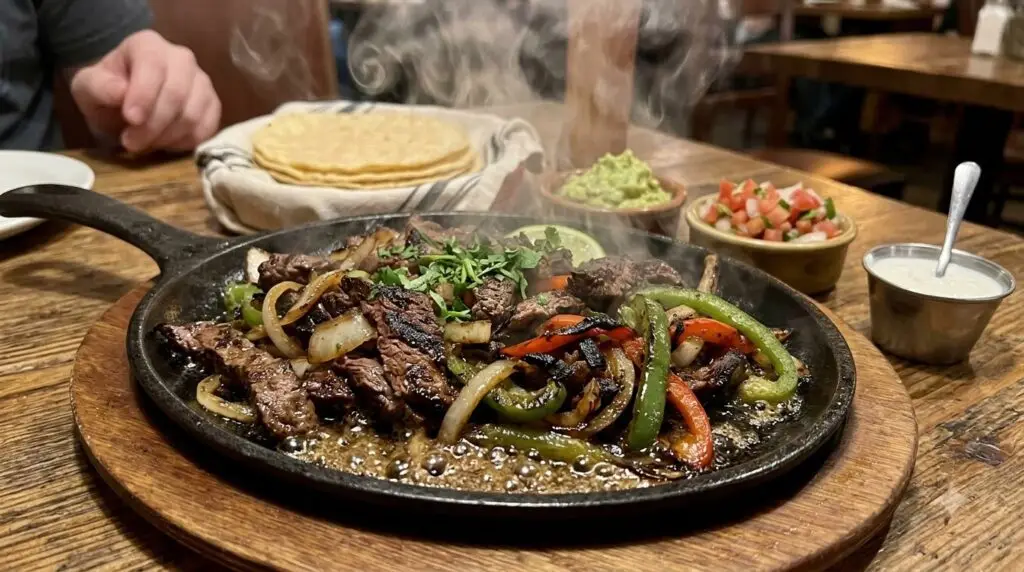
You hear them before you see them.
A server walks across the restaurant carrying a hot fajita platter, and suddenly there is that unmistakable sound:
Sssssssssss.
Steam rises from grilled meat, peppers and onions. The aroma reaches the table before the skillet does. Nearby diners look over, and the fajitas have already made an entrance before anyone takes a bite.
But why do fajitas sizzle?
The short answer is simple:
Moisture from the food hits an extremely hot surface and rapidly turns into vapor. That rapid bubbling and vaporization creates the sizzling sound.
But that is only one part of what makes restaurant fajitas so memorable.
The flavor comes from a different set of processes, including high-heat cooking and the Maillard reaction, while the hot serving skillet helps preserve temperature, release aromas and extend the sensory experience.
Here is what is actually happening from grill to skillet to first bite.
Quick Answer: Why Do Fajitas Sizzle?
Fajitas sizzle because water and other moisture from the meat, vegetables, cooking juices or sauce come into contact with a very hot skillet.
When that moisture reaches the heated surface, it rapidly changes into vapor.
The result is:
- Moisture contacts the hot skillet.
- Heat transfers into the liquid.
- The liquid begins rapidly boiling and vaporizing.
- Bubbles form and collapse.
- Escaping vapor and moving liquid create the characteristic sizzling sound.
So the simplest fajita formula is:
Hot skillet + moisture = sizzle
However, the sizzle itself is not what creates all of the browned, grilled flavor.
That requires another piece of food science.
Sizzle vs Sear: They Are Not the Same Thing
It is easy to assume that the sizzling noise means the fajitas are actively developing all their grilled flavor on the serving skillet.
Not necessarily.
Two separate processes are involved.
Sizzling
Sizzling is primarily connected to moisture rapidly heating and vaporizing on a hot surface.
It creates:
- Sound
- Steam
- Movement
- Aroma release
- Visual drama
Searing and Browning
Much of the rich grilled flavor is created earlier when meat and vegetables are exposed to sufficient heat during cooking.
This produces surface browning through reactions including the Maillard reaction.
So:
Sizzle = mostly heat interacting with moisture
Sear = browning and flavor development on the food’s surface
A great fajita experience combines both.
The food develops flavor during cooking, then the hot skillet keeps the sensory fireworks going at the table.
What Is the Maillard Reaction?
The Maillard reaction is one of the most important reasons grilled and seared foods develop complex flavor.
In simplified terms, amino compounds from ingredients such as proteins react with certain reducing sugars when heated, producing numerous new aroma, flavor and color compounds. Scientific reviews describe the Maillard reaction as a complex series of reactions involving amino groups from amino acids, peptides or proteins and carbonyl groups, particularly those from reducing sugars.
It contributes to the browned flavor found in foods such as:
- Seared meat
- Toasted bread
- Roasted coffee
- Grilled vegetables
- Other browned foods
For fajitas, this reaction helps produce:
- Savory roasted aromas
- Browned surfaces
- Deeper meat flavor
- Toasted notes
- More complex grilled character
Is the Maillard Reaction the Same as Caramelization?
No.
They are different processes.
Maillard browning involves reactions between amino compounds and reducing sugars.
Caramelization involves the thermal breakdown and transformation of sugars.
Both can contribute to cooked-food flavor, but they should not be treated as the same thing.
That distinction matters when explaining why grilled fajita meat and vegetables develop more complexity than simply becoming “caramelized.”
Why Moisture Helps the Sizzle but Can Work Against Browning
Here is one of the most interesting pieces of fajita food science:
Moisture creates the dramatic sizzle, but too much surface moisture can make strong browning harder to achieve.
Why?
Water must absorb energy and evaporate before the surface of the food can remain at the higher temperatures that favor rapid browning.
That means a wet piece of meat placed on a cooking surface may spend part of its cooking time steaming rather than immediately developing a deep sear.
This creates a balancing act.
For flavor development:
Enough heat + controlled surface moisture = stronger browning
For the table presentation:
Hot skillet + remaining moisture = dramatic sizzle
The best restaurant-style experience can therefore involve good browning during cooking followed by a controlled burst of moisture and heat on the serving skillet.
Why Are Fajitas Served on a Hot Skillet?
The skillet does more than produce noise.
Its stored heat keeps affecting the food after it leaves the kitchen.
It Keeps the Food Hot
A heavy heated skillet holds substantial thermal energy.
Instead of transferring fajitas onto a cool ceramic plate, serving them on a hot surface helps maintain their temperature longer.
It Extends the Sizzle
As long as:
- the skillet remains sufficiently hot, and
- moisture remains available,
vaporization can continue.
As the skillet cools and moisture decreases, the sizzling gradually fades.
It Helps Release Aroma
Heating food increases the release of volatile aroma compounds.
The warm vapor rising from fajitas can carry aromatic compounds from:
- Meat
- Peppers
- Onions
- Seasonings
- Cooking juices
toward the diner.
That is one reason fajitas can seem to announce themselves from several tables away.
It Makes the Dish Interactive
A hot skillet also changes the way the meal feels.
Instead of receiving a fully assembled taco, diners can combine grilled ingredients, tortillas and toppings themselves.
The presentation becomes part of the meal.
Why Do Fajitas Smell So Strong Before You Taste Them?
What we call “flavor” is not produced by the tongue alone.
Aroma plays a major role in how food is perceived.
When fajitas arrive extremely hot, volatile aroma molecules are released into the air and reach the nose before the first bite.
The platter can produce aromas associated with:
- Browned meat
- Roasted peppers
- Cooked onions
- Spices
- Citrus
- Cooking fats
The combination of steam, heat and aromatic compounds creates a powerful first impression.
And because the diner hears the platter at roughly the same time, the experience is multisensory.
You are not simply tasting fajitas.
You are experiencing:
sound → aroma → sight → texture → taste
before and during the meal.
What Role Do Peppers and Onions Play?
Fajitas would be a very different experience without peppers and onions.
They contribute much more than color.
Peppers
Depending on variety and preparation, peppers can contribute:
- Natural sweetness
- Fresh vegetal flavor
- Roasted notes
- Texture
- Color
High-heat cooking can soften them while developing browned or blistered edges.
Onions
Raw onion begins with sharp sulfur-containing compounds and a crisp texture.
Cooking changes both.
As onions heat, they:
- Soften
- Lose some raw sharpness
- Develop sweeter-tasting notes
- Produce new cooked aromas
- Brown under the right conditions
This is why grilled onion aroma is so closely associated with the fajita experience.
Protein
The protein provides much of the savory foundation.
Surface browning can contribute rich roasted aromas, while the interior provides moisture and texture.
Together, browned protein plus peppers plus onions produce the familiar base before tortillas and toppings are even added.
Does Marinade Make Fajitas Sizzle?
Not directly.
A marinade can contribute moisture, so some of that liquid may participate in sizzling when exposed to a hot skillet.
But the main purpose of a marinade is flavor preparation, not producing sound.
Depending on the recipe, marinades may include ingredients such as:
- Citrus
- Chiles
- Garlic
- Herbs
- Spices
- Oil
- Salt
These ingredients primarily affect the surface and outer layers of the food.
Acidic marinades can also alter proteins at the surface, but more acid or more marinating time does not automatically mean more tender meat.
And there is another tradeoff:
A very wet surface can interfere with rapid browning.
So more marinade does not automatically equal better fajita char.
Why Does Lime Work So Well With Fajitas?
Grilled meat and cooked vegetables can produce rich, savory flavors.
Fresh lime adds contrast.
Its acidity can make a bite seem:
- Brighter
- Fresher
- Less heavy
- More balanced
That is why a relatively small squeeze of lime can noticeably change the overall impression of a fajita.
The same principle explains why fresh salsa, pico de gallo and other acidic toppings work well alongside rich grilled foods.
They introduce contrast rather than simply adding more richness.
Does the Sizzle Mean Fajitas Are Fresh?
No.
This is an important distinction.
A sizzling skillet tells you one thing with reasonable confidence:
the serving surface and/or food are very hot.
It does not prove:
- When ingredients were purchased
- How long food was stored
- Whether ingredients were freshly prepared
- Ingredient quality
- Overall food safety
A restaurant can create a strong sizzle simply by using a sufficiently heated platter and moisture.
So while the sound contributes to the perception of freshness and immediacy, sizzle is fundamentally evidence of heat and moisture, not a freshness test.
Why Do Fajitas Keep Sizzling at the Table?
Once the skillet leaves the kitchen, it still contains stored heat.
As juices and other moisture continue contacting the surface:
- Heat flows from the skillet into the liquid.
- Liquid continues boiling and vaporizing.
- Bubbles and vapor continue producing sound.
- The skillet gradually loses heat.
- Available surface moisture decreases.
- The sizzle eventually stops.
This explains why the loudest part usually happens near the beginning.
The skillet has the most heat and the food has the most available moisture.
A few minutes later, both conditions have changed.
Is the Cloud Above Fajitas Smoke or Steam?
What you see above the skillet is not necessarily all “smoke.”
The visible cloud can include water vapor that cools and condenses into tiny droplets, along with airborne droplets and aromatic compounds released from hot food and cooking fats.
Actual smoke can occur when oils or food components become hot enough to break down, but a visible cloud above a sizzling platter should not automatically be described as smoke.
Calling it steam and aromatic vapor is usually more accurate unless the food is genuinely smoking.
Why Restaurant Fajitas Can Feel Different From Homemade Fajitas
You can absolutely make flavorful fajitas at home.
What restaurants often add is consistency and presentation.
Heat Management
Restaurant equipment can make it easier to cook multiple components quickly while maintaining strong cooking temperatures.
Separate Cooking and Serving Stages
The meat and vegetables may develop their browning during cooking, while a separate hot platter is used to maintain temperature and presentation.
That distinction is important.
The sizzling serving skillet does not need to do all the cooking.
Timing
A strong fajita presentation depends on synchronization.
The food, skillet, tortillas and accompaniments need to arrive at the right time.
At home, you might finish the meat and then wait for tortillas.
In a restaurant kitchen, the goal is to make those components arrive together.
A Short History of Fajitas
Fajitas belong strongly to the history of Tex-Mex and Texas Mexican food.
The Texas State Historical Association identifies fajitas among traditional cattle-based foods associated with Mexican American foodways in Texas, particularly South Texas.
The Smithsonian’s National Museum of American History notes that fajitas became part of the expanding Tex-Mex restaurant landscape during the 1970s, identifying them with Houston as regional Mexican American and Tex-Mex foods spread more broadly through American restaurants.
The dish historically centered on beef, particularly skirt steak, while the modern restaurant category has expanded considerably.
Today you may encounter fajitas made with:
- Beef
- Chicken
- Shrimp
- Vegetables
- Mixed proteins
The definition has expanded, but the restaurant ritual of hot grilled ingredients, tortillas and build-your-own bites remains one of the dish’s most recognizable forms.
How to Build a Balanced Fajita Bite
Once the science experiment arrives at your table, the eating part is much simpler.
Start With a Warm Tortilla
Warm tortillas are softer and more flexible, making them easier to fold around the filling.
Add the Protein
Use enough to make it the center of the bite without overloading the tortilla.
Add Peppers and Onions
They contribute sweetness, roasted flavor and texture contrast.
Add Something Fresh
Depending on what is served, this might include:
- Pico de gallo
- Salsa
- Cilantro
- Guacamole
Add Acidity
A squeeze of lime can cut through rich meat and cooking fats.
Do Not Overfill
There is a narrow border between a well-built fajita and a tortilla experiencing structural failure.
Leave enough room to fold it.
Fajitas at Taco Tequila Co. in New Port Richey
This topic connects naturally with Taco Tequila Co. because the restaurant’s own website repeatedly identifies sizzling fajitas as part of its food offering.
Its About page lists sizzling fajitas among the Mexican staples served at the restaurant, alongside dishes such as guacamole, nachos and burritos.
Taco Tequila Co.’s existing restaurant content also describes sizzling fajita presentations with grilled peppers and onions, reinforcing the connection between the dish and the restaurant’s New Port Richey dining experience.
Specific proteins, sides, prices and menu combinations can change, so check the current menu or ask the restaurant about today’s fajita options when ordering.
What does not change is the science behind that first sound:
heat meets moisture, vapor escapes, aromas rise, and the table notices.
Frequently Asked Questions About Sizzling Fajitas
Why do fajitas sizzle?
Fajitas sizzle because moisture from the food or cooking liquid contacts a very hot skillet and rapidly vaporizes.
The movement of liquid, bubbles and escaping vapor creates the familiar sizzling sound.
Why are fajitas served sizzling?
A hot skillet helps keep the food warm, extends the sizzling effect, releases aromas and creates a dramatic table presentation.
Is the sizzle what cooks the fajitas?
Not necessarily.
Most or all of the required cooking may already happen before the food reaches the serving skillet.
The hot platter can continue surface heating, but its primary role may be temperature maintenance and presentation rather than fully cooking the ingredients.
Is sizzling the same as the Maillard reaction?
No.
Sizzling mainly involves moisture interacting with a hot surface.
The Maillard reaction involves heat-driven reactions between amino compounds and reducing sugars that contribute to browning, aroma and flavor.
Why do fajitas stop sizzling?
The skillet gradually loses heat, while available surface moisture also decreases.
Once there is not enough heat or moisture to sustain rapid vaporization, the sound fades.
Does more sizzle mean better fajitas?
No.
More liquid can produce more sizzling, but it does not automatically produce better browning or flavor.
In fact, excessive surface moisture can work against rapid searing.
Does sizzling mean the food is fresh?
No.
Sizzling tells you that the food and/or skillet are hot enough to rapidly heat moisture.
Freshness and ingredient quality cannot be determined from the sound.
What creates the browned flavor on fajitas?
High-heat cooking and browning reactions, particularly the Maillard reaction, contribute many of the roasted and savory flavors associated with seared meat and vegetables.
Why are fajitas different from tacos?
Tacos are generally served with fillings already placed inside tortillas.
Fajitas are commonly served as separate grilled components, often including meat, peppers and onions, with tortillas and toppings provided so diners can build each bite themselves.
Are fajitas Mexican or Tex-Mex?
Modern fajitas are strongly associated with Texas Mexican and Tex-Mex food traditions. Historical sources connect fajitas to Mexican American foodways in Texas, while restaurant popularity expanded substantially in the later 20th century.
Final Takeaway: The Sizzle Is Only the Beginning
So, why do fajitas sizzle?
Because moisture contacts a very hot skillet and rapidly turns into vapor.
But that sound is only one layer of the experience.
The full fajita effect comes from several things happening together:
Moisture creates the sizzle.
High-heat cooking creates browning.
The Maillard reaction builds roasted, savory flavor.
The hot skillet keeps the food warm.
Heat helps send aromas into the air.
Peppers, onions, meat, tortillas and fresh toppings create the final bite.
The skillet gets your attention, but the chemistry behind the food is what makes that first bite worth waiting for.
At Taco Tequila Co. in New Port Richey, sizzling fajitas are part of a dining experience designed to arrive with a little theatre built in.
Next time you hear that skillet coming across the room, you will know exactly what is happening.
The sound is not magic.
It is heat, moisture and food science making an entrance.