
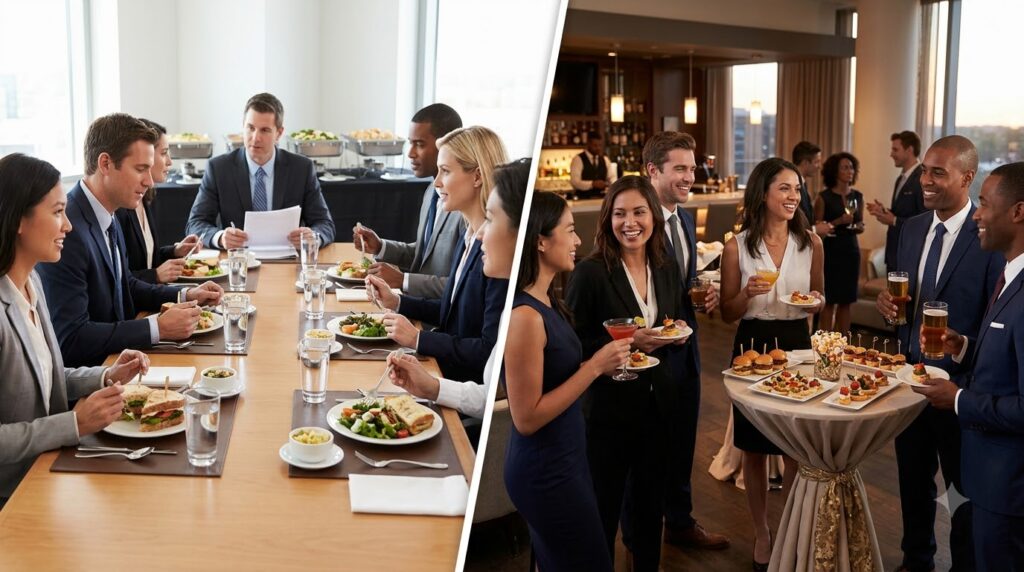
A client event can have excellent food, a polished venue, and a carefully chosen guest list and still feel wrong if the format does not support the reason everyone is there.
A lunch meeting and a happy-hour event can both work well for clients, but they encourage very different behavior.
Lunch naturally creates a defined beginning, a seated conversation, and a clearer agenda. Happy hour gives guests more freedom to circulate, meet multiple people, and let conversations develop informally.
So the best corporate catering event format is not simply the one that sounds more enjoyable.
It is the one that makes your business objective easier to accomplish.
If clients need to review a proposal, discuss performance, understand a product, or leave with clear next steps, lunch usually provides the stronger structure.
If the goal is client appreciation, networking, relationship building, team introductions, or celebrating a milestone, happy hour can create a more natural social environment.
And when you need both, a short structured presentation followed by a reception can bridge the two.
Quick Answer: Lunch Meeting or Happy Hour?
Use this comparison as a starting point.
| Business Need | Lunch Meeting | Happy Hour |
|---|---|---|
| Proposal or detailed discussion | Strong fit | Less ideal |
| Product presentation | Strong fit | Works for a short demo |
| Contract or project review | Strong fit | Usually too informal |
| Client appreciation | Works | Strong fit |
| Relationship building | Works | Strong fit |
| Networking | Limited by seating | Strong fit |
| Introducing several team members | Possible | Easier |
| Firm start and finish time | Strong fit | More flexible |
| Staggered guest arrival | Less convenient | Strong fit |
| Detailed documents or screens | Easier | Harder |
| Social atmosphere | Moderate | Strong |
| Flexible conversation | Moderate | Strong |
| Alcohol-centered option | Usually unnecessary | Optional |
| Predictable head count | Usually easier | Can be less predictable |
Neither column is automatically better.
The question is what you need people to do once they arrive.
Start With the Business Goal, Not the Meal Period
A common mistake is deciding:
“Let’s do lunch.”
Then trying to build a client event around lunch.
Reverse the process.
First ask what success looks like.
Do you need a decision by the end of the meeting?
Do you need to explain something complicated?
Do you want one client speaking primarily with one account team?
Or do you want fifteen clients meeting several people from your organization?
Those goals create completely different events.
A corporate catering event format should remove friction from the desired interaction.
If everyone needs to examine a document, giving them a seat and table makes sense.
If everyone needs to meet six new people, assigning them to one chair for ninety minutes works against the objective.
When a Catered Lunch Meeting Works Best
Lunch works particularly well when the food accompanies a business conversation rather than becoming the primary reason for gathering.
Imagine a client needs to review quarterly results.
There are four attendees.
You need a screen, several documents, forty minutes of discussion, and fifteen minutes for questions.
A lunch format gives that meeting a useful skeleton:
Arrival → Food → Discussion → Questions → Next steps
The meal can make the meeting more hospitable without changing its professional purpose.
Lunch is particularly useful for proposal reviews, account meetings, project updates, demonstrations, training sessions, planning discussions, small executive gatherings, and other events where concentration matters.
Why Lunch Can Make Client Scheduling Easier
A daytime meeting keeps the event inside the professional day.
That can be valuable when clients have family obligations, commutes, travel plans, or other evening commitments.
It also gives the invitation a clear expectation.
A client invited to a 12:00 PM to 1:30 PM lunch meeting usually knows approximately how much time to reserve.
The tradeoff is that the schedule becomes unforgiving.
If food arrives twenty minutes late during a ninety-minute meeting, you have lost a meaningful portion of the working time.
Lunch therefore rewards efficient service.
The Biggest Risk With Client Lunches: Trying to Do Too Much
A catered lunch is still a meeting.
Do not turn a ninety-minute client lunch into appetizers, a long welcome, multiple presentations, a complicated meal, an extended Q&A, three speeches, and a sales pitch that refuses to die.
Protect the actual purpose.
For many client lunches, a simple agenda is stronger:
- 10–15 minutes: Arrival and food
- 30–45 minutes: Main discussion
- 15–20 minutes: Questions and decisions
- 10 minutes: Wrap-up and next steps
Food should support the conversation rather than repeatedly interrupt it.
What Food Works Best for a Client Lunch?
Choose food that guests can comfortably eat while talking.
That does not necessarily mean boring food.
It means avoiding a service format that demands constant attention from the guest.
Menus with clearly portioned entrées, bowls, tacos, quesadillas, salads, sides, or a controlled buffet can work well depending on the meeting.
If guests will be reviewing documents, consider how much table space the meal requires.
If someone will be presenting, consider whether food service will create noise or movement at the same time.
If the meeting has only sixty minutes, avoid building the menu around a slow multi-stage service.
The better question is not:
“What is the most impressive menu?”
It is:
“What can guests enjoy without the meal fighting the agenda?”
When Happy-Hour Catering Works Better
Happy hour changes the geometry of the event.
Instead of keeping everyone focused on one conversation, it gives guests permission to move.
That makes it particularly useful for networking and relationship-focused client events.
Consider a company inviting twenty clients to meet sales, leadership, customer success, and operations team members.
A traditional seated lunch could trap each client beside only two or three people.
A reception format lets those conversations rotate naturally.
Happy-hour catering works particularly well for client appreciation, project celebrations, milestone events, networking gatherings, team introductions, informal product launches, and relationship-building events where completing a detailed agenda is not the main objective.
What Makes Happy Hour Different From “Drinks After Work”?
The event still needs structure.
A professional happy-hour event should not rely on alcohol to create the experience.
Guests may not drink for personal, medical, religious, professional, transportation, or other reasons.
Food should be substantial enough for the time of day, water should be obvious, and nonalcoholic beverages should feel like real options rather than an afterthought.
The value of the format comes from flexible conversation, not alcohol.
That distinction is important for client events.
What Food Works Best for a Client Happy Hour?
Happy-hour food needs to survive conversation.
Guests may be standing, moving, shaking hands, carrying a beverage, or speaking with several people in ten minutes.
That makes shareable items and smaller portions useful.
At Taco Tequila Co., the current restaurant menu includes Mini Street Tacos, TTC Quesadilla, and Chips and Salsa Trio, all examples of menu items that could form a starting point for a conversation about a more social food setup. Exact catering availability, portions, service format, and event pricing should be confirmed for the specific gathering.
The timing matters too.
If the event runs from 5:00 PM to 7:00 PM, guests may treat it as a pre-dinner gathering.
If it runs from 6:00 PM to 8:30 PM, many guests will reasonably expect food substantial enough to replace dinner.
Calling something “happy hour” does not erase hunger.
Client Lunch vs Happy Hour: How Guest Behavior Changes
This is one of the most useful ways to compare formats.
At lunch, the room usually has one dominant conversation.
At happy hour, the room may contain ten smaller conversations.
Neither pattern is inherently better.
A proposal review benefits from one conversation.
A client appreciation event may benefit from ten.
Before selecting the format, picture what you want the room to look like thirty minutes after guests arrive.
If everyone should be listening to the same person, lean structured.
If everyone should be talking to different people, lean social.
Which Format Works Better for a First Client Meeting?
For a small first meeting where you need to understand a client’s needs, a lunch can create more conversational focus.
You have a defined table, less movement, and more opportunity to stay with one discussion.
But context matters.
If the first interaction is part of a broader industry gathering or several people from both organizations need introductions, an informal reception may lower the pressure and create more conversational entry points.
Match the format to the number of relationships you are trying to establish.
Which Format Works Better for Client Appreciation?
Happy hour often fits appreciation events because there may be little need for an agenda.
The business objective is the experience itself.
You are thanking clients, strengthening relationships, or celebrating something accomplished together.
A short welcome can establish the purpose, after which guests can spend most of the event talking.
Lunch can still work well when the guest list prefers daytime meetings, the group is small, or a more intimate experience is appropriate.
“Appreciation” does not automatically mean “evening cocktails.”
Which Format Works Better for Presentations?
Usually lunch, particularly if the presentation requires attention.
A screen presentation, product walkthrough, performance review, or technical explanation benefits from seating and a controlled agenda.
Happy hour can support a presentation when the formal section is brief.
Think ten to twenty minutes, not an hour-long deck followed by the announcement that everyone can finally socialize.
If most of the event is presentation, call it a meeting.
Guests tend to appreciate accurate expectations.
Which Format Is Better for Networking?
Happy hour normally has the structural advantage because people can circulate.
A seated lunch can still support networking by intentionally changing seats or including pre-meal and post-meal conversation periods, but the table itself limits movement.
If the primary KPI is how many useful introductions occur, design the event so guests can actually move.
How Attendance Patterns Affect the Choice
Lunch usually works better when everyone needs to arrive together.
A 12:15 PM presentation cannot function particularly well if half the client group arrives at 12:50 PM.
Happy hour tolerates staggered arrivals much more naturally.
Someone can arrive at 5:15 PM, another at 5:45 PM, and another at 6:10 PM without breaking the entire event.
That flexibility can be useful when inviting clients from different offices or businesses.
But flexibility also creates uncertainty.
You may have twenty confirmed guests without knowing whether eighteen will be present simultaneously.
That affects food service and staffing.
Lunch vs Happy Hour: Which Is Easier to Budget?
Lunch can be easier to predict.
A confirmed group of twelve receiving a defined meal creates a relatively straightforward head-count calculation.
Happy hour can introduce more variables:
- How long will guests stay?
- Will food replace dinner?
- Will arrivals be staggered?
- What beverages will be offered?
- Will guests return for additional small plates?
- Does the event need staff throughout the entire reception?
The correct comparison therefore is not simply entrée price versus appetizer price.
Compare the complete event.
That includes food, beverages, service, room requirements, staffing, equipment, taxes, fees, and any audiovisual needs.
A cheaper menu does not necessarily create a cheaper event.
How Seating Changes the Event
Lunch normally needs enough seating for everyone.
That creates a predictable footprint but can require more formal planning.
Happy hour can combine high-top tables, limited seating, standing conversation areas, and lounge-style spaces depending on the venue.
Do not eliminate seating entirely.
Some guests may need it for comfort or accessibility.
For corporate events, the layout should support both the business objective and the people attending.
What About Alcohol at a Corporate Happy Hour?
Treat alcohol as optional.
Before including it, consider company policies, client expectations, transportation, timing, venue rules, and the culture of the group.
A well-designed happy hour should still work perfectly for a guest who orders no alcohol at all.
That means thoughtful nonalcoholic options, substantial food, water, and a format built around conversation rather than drinking.
If alcohol would complicate the event, you can still use the same social reception structure without it.
The networking format matters more than the cocktail.
When a Hybrid Client Event Works Better Than Either Option
Sometimes the lunch-vs-happy-hour question is asking you to choose between two things you actually need.
You need to communicate information.
You also need relationship time.
That is where a hybrid format can work.
For example:
| Time | Activity |
|---|---|
| 5:00 PM | Guest arrival |
| 5:15 PM | Welcome |
| 5:20 PM | 15-minute presentation |
| 5:35 PM | Questions |
| 5:45 PM | Food and networking |
| 7:00 PM | Event concludes |
The formal section establishes value.
The reception gives clients space to follow up naturally.
The critical rule is to keep the presentation proportional.
A “happy hour” containing sixty minutes of PowerPoint before anyone can talk is simply a meeting wearing party shoes.
Lunch, Happy Hour, or Hybrid? Use This Decision Matrix
| If Your Priority Is… | Best Starting Format |
|---|---|
| Reviewing a proposal | Lunch |
| Making a business decision | Lunch |
| Training or education | Lunch |
| Detailed product demo | Lunch |
| Account review | Lunch |
| Client appreciation | Happy hour |
| Networking | Happy hour |
| Introducing several team members | Happy hour |
| Celebrating a completed project | Happy hour |
| Brief update plus networking | Hybrid |
| Product announcement plus relationship building | Hybrid |
| Formal discussion plus social follow-up | Hybrid |
This is a planning framework, not a rigid rule.
Guest availability can override it.
An ideal happy-hour concept does not help if your priority clients cannot attend evenings.
The Guest List Can Change the Right Format
A client event for six people behaves differently from one for sixty.
For a small group, lunch provides room for deeper conversations.
For a larger gathering, forcing everyone into one conversation can become awkward.
As guest count rises, ask whether all attendees need the same information.
If yes, create a presentation component.
If no, design around smaller conversations and movement.
This also affects catering.
A six-person executive lunch and a sixty-person networking reception need very different food-service plans even when the business goal is similar.
Questions to Answer Before Booking a Corporate Client Event
Before contacting a venue or caterer, prepare:
- What is the primary business objective?
- Who absolutely needs to attend?
- How many guests are expected?
- Do guests need to arrive simultaneously?
- How much formal presentation time is required?
- Will guests need tables for laptops, notes, or documents?
- Is networking a primary objective?
- Does the event overlap lunch or dinner?
- What dietary requirements need to be handled?
- Do you need audiovisual equipment?
- Will beverages include alcohol?
- What is the target end time?
- Do you need a private room?
- Is parking important for the guest group?
- What complete per-person or event budget are you working with?
Those answers are much more useful to an event team than saying:
“We need a corporate event for 30 people.”
Corporate Client Events at Taco Tequila Co. in New Port Richey
For businesses considering New Port Richey, Taco Tequila Co. currently lists lunch and dinner from 12:00 PM to 10:00 PM daily and happy hour Monday through Friday from 5:00 PM to 7:00 PM. Its website also provides a Catering | Event inquiry form.
That schedule makes both concepts relevant for client planning: a daytime meal or an early-evening social gathering.
The restaurant is located at 5316 US-19 N, New Port Richey, FL 34652.
Current menu examples include Mini Street Tacos, TTC Quesadilla, and Chips and Salsa Trio, alongside the restaurant’s broader Mexican-inspired menu.
For an actual corporate event, confirm current menu availability, group arrangements, catering options, pricing, room requirements, dietary accommodations, and service details directly with the event team.
What If Your Corporate Event Is Larger Than a Restaurant Gathering?
For larger groups, the same New Port Richey address also includes Trio’s Banquet Hall.
Trio’s currently lists 4,500 square feet of event space, capacity for up to 250 guests in the full hall or up to 120 guests in half the hall, and corporate events and conferences among its listed uses.
Its banquet-hall information also describes professional AV equipment, including a sound system with Bluetooth connectivity and microphones available for rent, plus round banquet tables or classroom-style layouts for presentations and seminars, and complimentary guest parking.
For a small executive client lunch, Trio’s also lists a private boardroom for up to 10 guests in a roundtable setting, suited to executive meetings, planning sessions, and private discussions.
This creates a useful distinction.
A smaller client lunch or happy-hour gathering may fit naturally around the restaurant experience.
A larger presentation, company reception, conference-style gathering, or client event needing a dedicated layout may call for a more formal event-space discussion.
Do not assume the same package or setup applies to both.
How to Request a Better Corporate Event Quote
A useful event inquiry should communicate the format and objective, not just the guest count.
Instead of:
“We need food for 25 clients.”
Try:
“We’re planning a client appreciation event for approximately 25 guests on a Thursday evening. We’d like a short 10-minute welcome followed by 90 minutes of networking, with substantial shareable food and both alcoholic and nonalcoholic beverage options. We would also like to know what private or semi-private setup options are available.”
For lunch:
“We’re planning a 14-person client meeting from noon to 1:30 PM. We need a quiet setup for a 30-minute presentation followed by discussion, efficient lunch service, vegetarian options, and information on any available audiovisual equipment.”
Now the venue can solve the right problem.
Frequently Asked Questions
Is lunch or happy hour better for a client event?
Lunch generally fits structured discussions, presentations, reviews, and meetings with clear action items. Happy hour usually fits networking, client appreciation, introductions, and relationship building. The better format depends on what guests need to accomplish.
What is a corporate catering event format?
It is the combination of event timing, meal structure, service style, seating, guest flow, and agenda used to support a business gathering. Examples include catered lunches, receptions, breakfast meetings, dinners, and hybrid presentation-plus-networking events.
How long should a client lunch meeting last?
Many client lunches can fit comfortably into roughly 60 to 90 minutes when the agenda is focused and food service is efficient. More complex presentations may require additional time.
How long should a client happy hour last?
Around 90 minutes to two hours can give guests enough time to arrive, eat, and have multiple conversations without making the gathering feel endless. Adjust the duration to the guest group and purpose.
Should a happy-hour client event include dinner?
If the event overlaps the normal dinner period, offer food substantial enough that guests are not left wondering whether they need another meal afterward. The exact amount depends on timing, duration, and menu.
Should alcohol be served at a corporate happy hour?
It is optional. The event should provide strong nonalcoholic choices and should not make drinking central to participation.
Which format is better for a product presentation?
A structured lunch normally works better for a detailed presentation. A short demo can also precede a happy-hour reception when networking is equally important.
Which format is better for client appreciation?
Happy hour can be particularly effective because it allows informal conversation and flexible networking, although a smaller daytime lunch may be better when clients prefer business-hour events.
Can lunch and happy hour be combined?
Yes. A hybrid event can begin with a short formal presentation and transition into a social reception. This works when both communication and relationship building matter.
Does Taco Tequila Co. host catering and event inquiries?
Yes. Its website has a Catering | Event inquiry form on the Contact page and lists its New Port Richey contact information. Exact group packages and arrangements should be confirmed directly for your date.
What options are available for a larger corporate event?
Trio’s Banquet Hall at the same New Port Richey address lists 4,500 square feet of space, capacity for up to 250 guests (or up to 120 in half the hall), corporate events and conferences among its uses, and a private boardroom for up to 10 guests.
Final Takeaway: Design the Event Around What Clients Need to Do
The best corporate catering event format is not determined by whether your team personally prefers tacos at noon or cocktails at five.
Start with the outcome.
If clients need to focus, review, learn, decide, or leave with specific next steps, build the event around structure. A catered lunch is often the cleaner fit.
If clients need to connect, meet people, celebrate, or strengthen relationships, create room for movement and conversation. Happy hour often supports that goal more naturally.
If you need both, do not force the entire event into one category.
Give the formal content a short, clearly defined window and let the rest of the event become social.
For companies considering Taco Tequila Co. in New Port Richey, the venue’s current operating schedule supports both daytime dining and weekday happy-hour timing, while catering and event inquiries can be submitted directly through the restaurant. Larger groups can also explore the neighboring Trio’s event-space options.
Choose the business objective first.
Then choose the room, schedule, food, and service format that make that objective easier to achieve.